
TL;DR:
- Automated trading analysis involves rigorous pre-deployment evaluation, backtesting, optimization, and validation.
- Proper data quality and avoiding overfitting, look-ahead bias, and regime shifts are essential for reliable results.
- Combining automated analysis with human judgment and behavioral review yields the best trading performance.
Most traders assume that once you automate your analysis, the hard work is done. Set it up, let it run, collect profits. That assumption is exactly what gets accounts blown. Automated trading analysis is not a shortcut. It is a disciplined, systematic process that demands as much rigor as any manual approach, and in some ways more. This guide breaks down what automated trading analysis actually means, the methods and metrics that matter, the traps that catch even experienced traders, and the practical steps you can take right now to apply it with confidence across forex, indices, and crypto markets.
Table of Contents
- Defining automated trading analysis
- The core process: Methods and key metrics
- Common pitfalls and advanced challenges
- Automated analysis vs. discretionary methods: Strengths and limits
- Applying automated trading analysis for better results
- A trader's perspective: What most guides miss about automating analysis
- Enhance your trading with automated analysis tools
- Frequently asked questions
Key Takeaways
| Point | Details |
|---|---|
| Thorough analysis is vital | Profitable automated trading starts with rigorous evaluation, not just automation. |
| Beware common traps | Overfitting, hidden costs, and execution errors are frequent ways traders lose expected gains. |
| Metrics guide performance | Using clear metrics and backtesting helps ensure strategies hold up in live trading. |
| Hybrid methods are emerging | Combining automated and discretionary strategies can boost robustness in changing markets. |
Defining automated trading analysis
Before you can use something effectively, you need to know exactly what it is. A lot of traders confuse automated trading analysis with automated trading itself. They are related but not the same thing.
Automated trading analysis is the work you do before a strategy goes live. As defined in the field, automated trading analysis refers to the systematic evaluation, backtesting, optimization, and validation of automated trading strategies using historical data, performance metrics, and rigorous methodologies to ensure robustness before live deployment.
In plain terms: you are stress-testing your strategy against real market data, measuring how it would have performed, and fixing weaknesses before real money is at risk.
The workflow typically follows four stages:
- Evaluation: Defining the strategy logic and identifying what market conditions it targets
- Backtesting: Running the strategy against historical price data to measure past performance
- Optimization: Adjusting parameters to improve results without overfitting to past data
- Validation: Confirming the strategy holds up on out-of-sample data and in forward testing
Who uses this process? Individual retail traders building their first algorithmic system, professional quant traders managing institutional capital, and prop traders who need to prove edge before scaling. The tools differ, but the core process is the same.
"The goal of automated trading analysis is not to find a perfect backtest. It is to find a strategy that survives contact with live markets."
This distinction matters enormously. A strategy with a flawless backtest but no validation process is a liability, not an asset. The analysis phase is what separates traders who last from those who blow up in the first volatile quarter.
Data quality is also foundational here. Garbage data produces garbage results. Clean, tick-level or minute-level historical data, adjusted for splits and dividends, is the baseline requirement for meaningful analysis. Many beginners skip this step and wonder why their live results look nothing like their backtest.
The core process: Methods and key metrics
Once you understand what automated trading analysis is, the next step is knowing which tools and metrics actually tell you something useful.
The process runs in a clear sequence:
- Backtesting: Simulate the strategy on historical data to get baseline performance numbers
- Forward-testing: Run the strategy on recent, unseen data (paper trading) to check real-world behavior
- Optimization: Tune parameters within reasonable ranges, always testing on separate data sets
- Live deployment: Start with minimal position sizes, monitor closely, and scale only after consistent results
Now, the metrics. Not all performance numbers are created equal. Here are the ones that actually matter:
| Metric | What it measures | Why it matters |
|---|---|---|
| Sharpe ratio | Return per unit of risk | Higher values mean better risk-adjusted performance |
| Max drawdown | Largest peak-to-trough loss | Tells you the worst-case pain you would have endured |
| Profit factor | Gross profit divided by gross loss | Above 1.5 is generally considered acceptable |
| Win rate | Percentage of winning trades | Meaningless without average win/loss size context |
| Expectancy | Average profit per trade | The single most honest measure of edge |
These metrics work together. A 90% win rate means nothing if the average loss wipes out ten wins. Expectancy ties it all together and gives you a single number that reflects whether your strategy actually has edge over time.
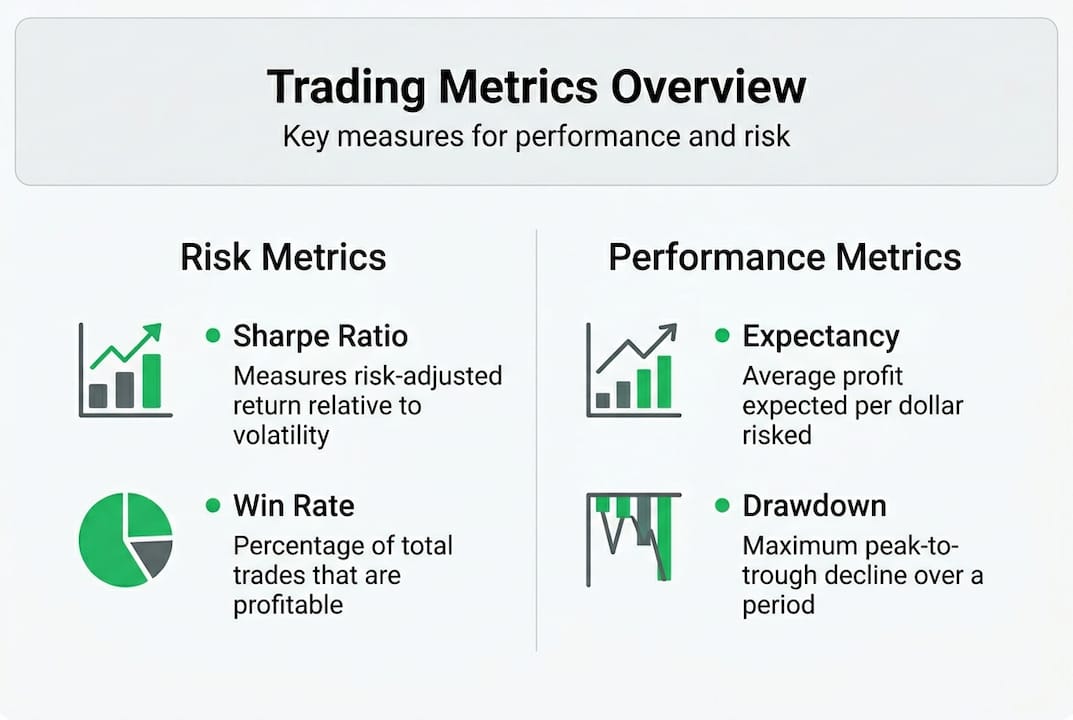
For AI analysis tools that automate much of this metric calculation, the key is still understanding what the numbers mean before you trust them blindly.
Pro Tip: Never deploy a strategy live without at least 200 to 300 trades in your backtest sample. Anything less and your metrics are statistically unreliable, no matter how good they look.
Forward-testing on paper before risking real capital is non-negotiable. The market does not care how clean your backtest looks. Paper trading reveals execution realities, slippage, and behavioral responses that no backtest can fully simulate.
Common pitfalls and advanced challenges
Understanding the process is one thing. Avoiding the mistakes that quietly destroy performance is another. These pitfalls are not obvious, which is why even experienced traders fall into them.
The most dangerous errors in automated trading analysis include:
- Overfitting (curve-fitting): Tuning parameters so tightly to historical data that the strategy only works on that specific data set
- Look-ahead bias: Accidentally using future data in your backtest, making results look far better than reality
- Survivorship bias: Testing only on assets that survived, ignoring the ones that crashed or were delisted
- Regime shifts: A strategy built for a bull market will often collapse in a bear market or high-volatility period
- Slippage and transaction costs: Transaction costs and slippage can erase 20 to 40% of theoretical returns, a figure most beginners dramatically underestimate
- Execution risks: Latency, partial fills, and API downtime can all cause live results to diverge sharply from backtested expectations
Overfitting deserves extra attention because it is so seductive. When you optimize a strategy and the backtest equity curve looks like a straight line going up, that feels like success. It is usually the opposite. The more parameters you tune, the more you are fitting noise rather than signal.
The fix is out-of-sample testing. Split your historical data: use 70% for development and hold back 30% for validation. If performance collapses on the holdout set, you have overfitted.
Pro Tip: Log every failed strategy attempt alongside your successful ones. Patterns in your failures reveal systematic blind spots in your analysis process that you will never catch by only studying winners.
Regime shifts are the silent killer of automated strategies. A system built on 2021 crypto data will behave very differently in a 2022 or 2024 environment. Conservative assumptions and stepwise scaling, starting with one market before expanding, give your strategy room to adapt without catastrophic losses.
Automated analysis vs. discretionary methods: Strengths and limits
Automated analysis does not exist in a vacuum. Understanding how it compares to discretionary and hybrid approaches helps you deploy the right tool at the right time.
| Criteria | Automated | Discretionary | Hybrid |
|---|---|---|---|
| Efficiency | Very high | Low to medium | High |
| Emotional control | Excellent | Weak | Good |
| Adaptability | Poor in chaos | Strong | Very good |
| Consistency | High | Variable | High |
| Best market condition | Trending, normal | Volatile, uncertain | All conditions |
The research is clear on this tradeoff. Automated systems excel in efficiency and consistency but fail during regime changes and black swan events, while discretionary traders perform better in uncertainty. Quantitative approaches shine in normal market conditions, discretionary judgment proves its value in crashes, and hybrid models are increasingly the preferred approach for serious traders.
"Automation removes emotion but cannot replace judgment. Discretion adds adaptability but invites bias. The hybrid model is not a compromise. It is an upgrade."
This is a critical insight for traders who treat automation as an all-or-nothing choice. The best professional setups use automated analysis to handle the data-heavy, repetitive work, and human judgment to interpret context, manage risk during unusual conditions, and decide when to pause a system entirely.
Pure automation works well in liquid, trending markets with stable volatility regimes. The moment conditions shift sharply, such as during a central bank surprise or a geopolitical shock, rule-based systems often generate signals that a human trader would immediately recognize as wrong.
Knowing when to trust your automated analysis and when to override it is itself a skill worth developing deliberately.
Applying automated trading analysis for better results
Theory without application is just noise. Here is how to actually put robust automated trading analysis to work in your trading.
- Start with a simple strategy: One entry condition, one exit condition, one risk rule. Complexity is the enemy of clarity at the analysis stage.
- Use AI tools for backtesting: Modern AI backtesting engines with multi-indicator deep reinforcement learning can surface patterns no manual review would catch, but start small and validate every output.
- Paper trade and track results: Run the strategy in a simulated environment for at least four to eight weeks before committing real capital.
- Gradually scale position sizes and markets: Once live results match forward-test expectations, increase size incrementally. Do not jump from micro lots to full size overnight.
- Review and adapt regularly: Markets evolve. Schedule monthly performance reviews and be willing to retire a strategy that stops working.
Behavioral discipline matters here as much as technical rigor. The biggest mistake traders make after deploying an automated strategy is over-tweaking it after a few losing trades. Every system has drawdown periods. Changing parameters after every loss is just discretionary trading in disguise.
Common early mistakes to avoid:
- Skipping forward-testing because the backtest looks good
- Using the same data set for both optimization and validation
- Ignoring commission and spread costs in performance calculations
- Treating a two-week paper trade as sufficient validation
- Scaling position sizes before achieving statistical significance in live results
Patience is the most underrated edge in automated analysis. The traders who build lasting systems are the ones who resist the urge to rush from backtest to full deployment.
A trader's perspective: What most guides miss about automating analysis
Here is what the standard tutorials rarely tell you: automated trading analysis can give you a false sense of certainty that is more dangerous than having no system at all.
When you have a clean backtest, a solid Sharpe ratio, and a validated strategy, it is tempting to stop questioning it. That is the trap. Markets are not static, and the confidence a good backtest generates can make you slower to recognize when conditions have changed and your system is no longer relevant.
The traders who get the most from automated analysis are the ones who combine system metrics with behavioral review. They track not just whether the strategy is profitable, but whether they are executing it consistently, whether their emotional responses are interfering with position sizing, and whether they are making discretionary overrides that undermine the data.
Starting with manual trade logging, even for a few months before automating, gives you a ground-level understanding of your own patterns that no algorithm can provide. That self-knowledge becomes your edge when interpreting why your automated system is behaving the way it is.
The real power of automated analysis is not that it removes human judgment. It is that it gives human judgment better data to work with.
Enhance your trading with automated analysis tools
Everything covered in this guide, from backtesting to behavioral tracking, requires consistent data capture and smart analytics to execute well. That is exactly where the right platform makes the difference.
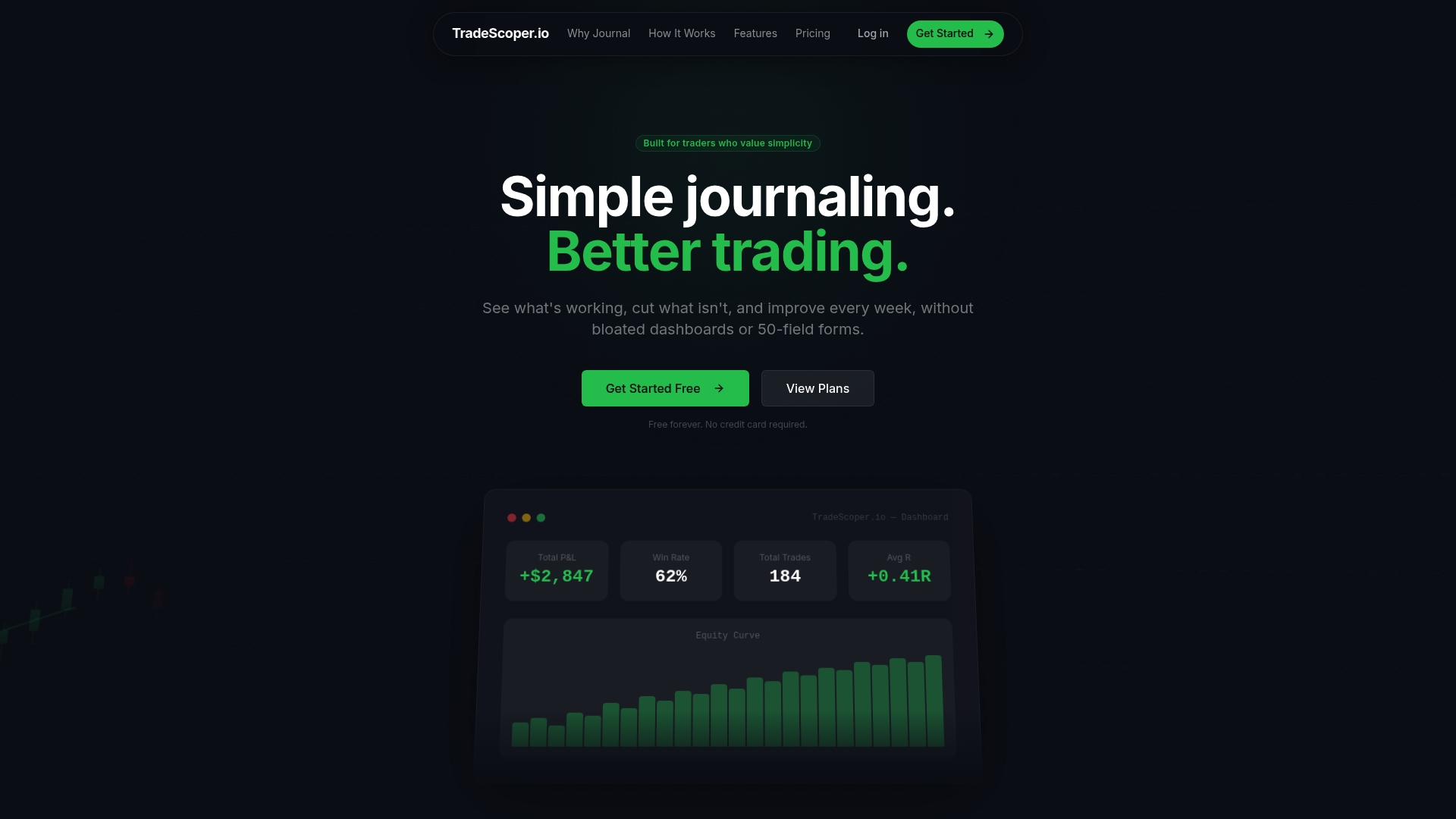
TradeScoper.io is built for traders who take performance seriously. The AI-powered trading journal captures your trade data, surfaces patterns in your results, and tracks the behavioral factors that most platforms ignore entirely. Whether you are validating a new automated strategy or reviewing months of live performance, TradeScoper.io gives you the analytical clarity to act with confidence. Start with the free tier and see what your data has been trying to tell you.
Frequently asked questions
How does automated trading analysis differ from automated trading?
Automated trading analysis assesses and optimizes strategies before live deployment, while automated trading executes trades based on those strategies. The analysis phase is the validation work that happens first.
What are the biggest risks in relying only on automated analysis?
Overfitting, ignoring regime changes, and underestimated costs can all undermine performance if not addressed. Slippage and transaction costs alone can erase 20 to 40% of expected returns.
Can beginners use automated trading analysis effectively?
Yes, starting with simple strategies and paper trading allows beginners to learn and improve safely. Starting small and scaling gradually is the recommended path for anyone new to the process.
Is a hybrid approach better than pure automation?
Hybrid approaches can offer adaptability and robustness, especially during volatile or unexpected market events. Research shows hybrid models outperform pure automation during market crashes and regime shifts.