TL;DR:
- Successful forex trading depends equally on behavioral discipline and technical analysis.
- Combining technical, fundamental, and sentiment analysis provides a comprehensive trading decision framework.
- Mastering risk management and emotional control creates the true competitive edge in trading.
Most traders spend years chasing the perfect indicator, only to blow their accounts on a single emotional decision. Successful forex trading is not just about reading charts or predicting price direction. It is as much behavioral as analytical, and the traders who last are the ones who understand both sides. This guide breaks down the core types of forex trading analysis, explains how risk psychology shapes every trade you take, and gives you actionable techniques to sharpen your performance. Whether you trade part-time or manage multiple accounts professionally, what follows will reframe how you think about your edge.
Table of Contents
- The fundamentals of forex trading analysis
- Technical, fundamental, and sentiment analysis explained
- Behavioral insights: Managing risk and decision biases
- Advanced tools and strategies: AI, ML, and dynamic risk models
- Why mastering behavioral analysis is the real edge
- Take your forex analysis further with TradeScoper.io
- Frequently asked questions
Key Takeaways
| Point | Details |
|---|---|
| Analysis diversity | Effective forex trading blends technical, fundamental, sentiment, and behavioral insights. |
| Behavioral discipline | Strict risk rules and self-awareness help traders counter psychological biases like loss aversion. |
| AI and ML value | Advanced technology improves analysis but must be paired with custom risk management routines. |
| Practical integration | Successful traders use analytical methods alongside behavioral routines and performance journals. |
| Continuous improvement | Ongoing learning and self-audit maximize trading effectiveness in a changing market landscape. |
The fundamentals of forex trading analysis
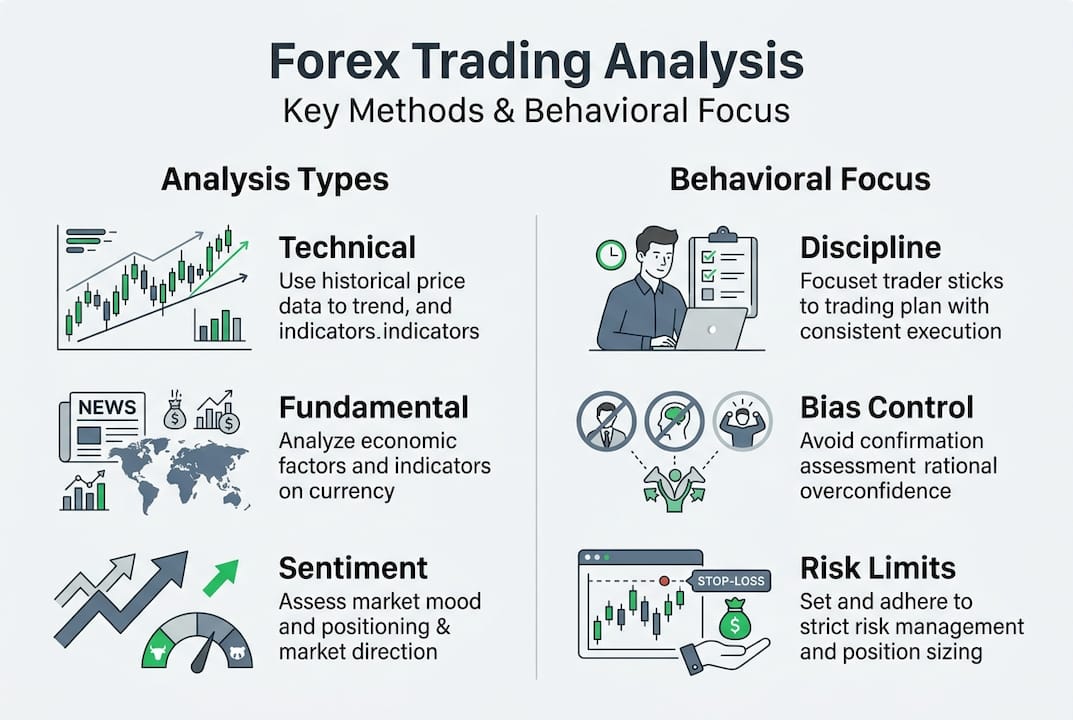
Forex trading analysis is the process of evaluating currency pairs to make informed buy or sell decisions. It combines quantitative tools like charts and economic data with qualitative factors like market sentiment and trader behavior. The goal is not to predict the future with certainty. The goal is to build a decision framework that tilts probability in your favor over hundreds of trades.
There are four main pillars of forex analysis:
- Technical analysis: Studies historical price action, chart patterns, and indicators to forecast future movement
- Fundamental analysis: Examines macroeconomic data, central bank policy, and geopolitical events that drive currency value
- Sentiment analysis: Measures how the crowd is positioned and whether market psychology is creating opportunity or risk
- Behavioral analysis: Tracks your own decision patterns, emotional states, and cognitive biases to improve consistency
Most traders focus on the first two and ignore the last two entirely. That is a costly mistake.
Here is a quick breakdown of how each pillar contributes to your overall edge:
| Analysis type | Primary focus | Best used for |
|---|---|---|
| Technical | Price, volume, patterns | Entry and exit timing |
| Fundamental | Economic events, policy | Directional bias |
| Sentiment | Positioning, crowd behavior | Avoiding crowded trades |
| Behavioral | Your own decisions and emotions | Consistency and discipline |
One of the most overlooked facts in trading is that behavioral discipline in risk management is just as crucial as any technical setup. You can have the best strategy in the world and still lose money if your position sizing is inconsistent or you exit trades based on fear rather than logic.
Understanding risk management basics is not optional. It is the foundation that makes every other form of analysis worth applying. When you combine solid risk rules with the right trade analysis tools, you stop guessing and start operating with a real system.
Technical, fundamental, and sentiment analysis explained
Each of the three primary analysis methods has a distinct role. Using only one is like navigating with half a map.
Technical analysis is built on the idea that price reflects all available information. Traders use candlestick charts, moving averages, RSI, MACD, and support and resistance levels to identify patterns and time entries. It works best in trending or ranging markets where historical behavior repeats. The main weakness is that it can fail during major news events when price moves are driven by fundamentals, not patterns.
Fundamental analysis looks at the forces that actually move currencies over time. Interest rate decisions, inflation data, employment figures, and GDP reports all shift currency valuations. A trader who understood that the Federal Reserve was moving toward rate hikes in 2022 had a structural edge in USD pairs that no chart pattern could provide. The limitation is timing. Fundamentals can take weeks or months to play out, making them less useful for short-term entries.
Sentiment analysis is the most underused of the three. It measures how traders are collectively positioned using tools like the Commitment of Traders (COT) report, retail sentiment data from brokers, and options market positioning. Sentiment analysis helps avoid crowded trades in volatile regimes, which is exactly when most retail traders get caught on the wrong side.
Here is a comparison of the three methods:
| Method | Time horizon | Data source | Key risk |
|---|---|---|---|
| Technical | Short to medium term | Price charts | Fails in news-driven moves |
| Fundamental | Medium to long term | Economic data | Timing is unpredictable |
| Sentiment | Short to medium term | Positioning data | Contrarian signals can be early |
Pro Tip: Use fundamental analysis to set your directional bias for the week, then use technical analysis to time your entries. Add sentiment data to avoid entering when the crowd is already maxed out in your direction. This three-layer approach filters out a large percentage of low-quality setups.
Understanding your risk exposures across different currency pairs becomes much clearer when you apply all three methods together. And tracking the psychological factors in trading that influence your decisions adds the fourth layer that separates good traders from great ones.

Behavioral insights: Managing risk and decision biases
You can master every technical indicator and still sabotage yourself with poor decision-making under pressure. Behavioral finance research has identified several cognitive biases that consistently hurt traders.
Here are the most damaging ones, in order of impact:
- Loss aversion: The pain of a loss feels roughly twice as intense as the pleasure of an equivalent gain. This causes traders to hold losing trades too long and cut winning trades too early.
- Overconfidence: After a winning streak, traders often increase position sizes beyond their risk plan, exposing themselves to account-damaging drawdowns.
- Pattern chasing: The brain is wired to find patterns, even in random data. Traders often see setups that are not there, especially after a losing period when they feel pressure to recover.
- Recency bias: Overweighting recent events leads traders to assume the current market regime will continue indefinitely, missing major reversals.
- Anchoring: Fixating on an entry price or a previous high or low distorts objective analysis of where the market actually is.
Loss aversion and crowded trades are among the most documented behavioral pitfalls in trading psychology research. The fix is not willpower. It is structure.
"The trader who builds strict rules around position sizing, stop placement, and trade frequency removes the moment-to-moment decisions where bias does the most damage."
Practical solutions include keeping a detailed trading journal that logs not just entries and exits but your emotional state and reasoning at the time. Reviewing this data weekly reveals patterns you would never notice in the moment. AI-powered analytics can accelerate this process by flagging trades where your behavior deviated from your stated rules.
Pro Tip: Set your stop loss and take profit levels before entering a trade, not after. This removes the temptation to move them based on how the trade feels while it is open.
Building risk controls in forex into your daily routine is what makes behavioral discipline sustainable. One useful reference for structuring this is currency risk analytics, which outlines how professional risk managers approach decision frameworks systematically.
Advanced tools and strategies: AI, ML, and dynamic risk models
The last decade has brought a wave of advanced analytical tools into retail trading. Machine learning (ML) models can now scan thousands of currency pairs, identify statistical patterns, and generate trade signals faster than any human. But the technology comes with important caveats.
Here is what modern advanced tools actually offer:
- AI-powered pattern recognition: Identifies recurring setups across large datasets that would take a human analyst weeks to find manually
- Sentiment aggregation engines: Pull data from news feeds, social media, and positioning reports to generate real-time crowd sentiment scores
- Dynamic risk models: Adjust position sizing and exposure limits based on current volatility, correlation between pairs, and drawdown thresholds
- Backtesting platforms: Allow traders to test strategies against historical data before risking real capital
- Trade journaling with behavioral tagging: Log trades with emotional and contextual metadata to identify behavioral patterns over time
The critical insight here is that ML aids but requires separate risk models to function safely. Machine learning excels at finding historical patterns, but it cannot predict black swan events, central bank surprises, or geopolitical shocks. Relying on an ML signal without an independent risk framework is one of the fastest ways to blow up a well-performing strategy.
Professional traders use these tools as inputs, not as complete systems. The model generates a signal. The risk model determines whether the signal is worth taking given current volatility and exposure. The trader reviews both before executing.
A useful framework for integrating technology with discipline is outlined in financial risk reduction strategies, which shows how institutional traders layer automated signals with manual oversight.
Using a trading journal platform that incorporates AI analytics helps bridge the gap between raw data and behavioral improvement. The technology surfaces what your spreadsheet cannot: the connection between your emotional state and your trade outcomes.
Why mastering behavioral analysis is the real edge
Here is an uncomfortable truth most trading educators avoid: the majority of traders who fail are not failing because they lack a good strategy. They are failing because they cannot execute their strategy consistently under pressure.
We have seen traders with statistically profitable systems lose money for months because they kept overriding their rules during drawdowns. And we have seen traders with mediocre setups outperform because they followed their risk rules without exception. The edge is behavioral, not analytical.
Conventional trading education focuses almost entirely on finding better signals. But a 60% win rate strategy executed with discipline beats a 70% win rate strategy executed emotionally every time. Even with automation, human discipline remains vital because markets evolve and automated systems require ongoing human judgment to remain relevant.
The traders who build lasting careers are the ones who treat their behavioral patterns as seriously as their chart patterns. They review their journals. They track their emotional states. They build routines that protect their decision-making when markets get chaotic. That is the real edge, and it is available to every trader willing to do the work.
Take your forex analysis further with TradeScoper.io
Turning analytical knowledge into consistent trading performance requires more than reading about it. You need a system that captures your trades, surfaces your patterns, and helps you connect your decisions to your results over time.
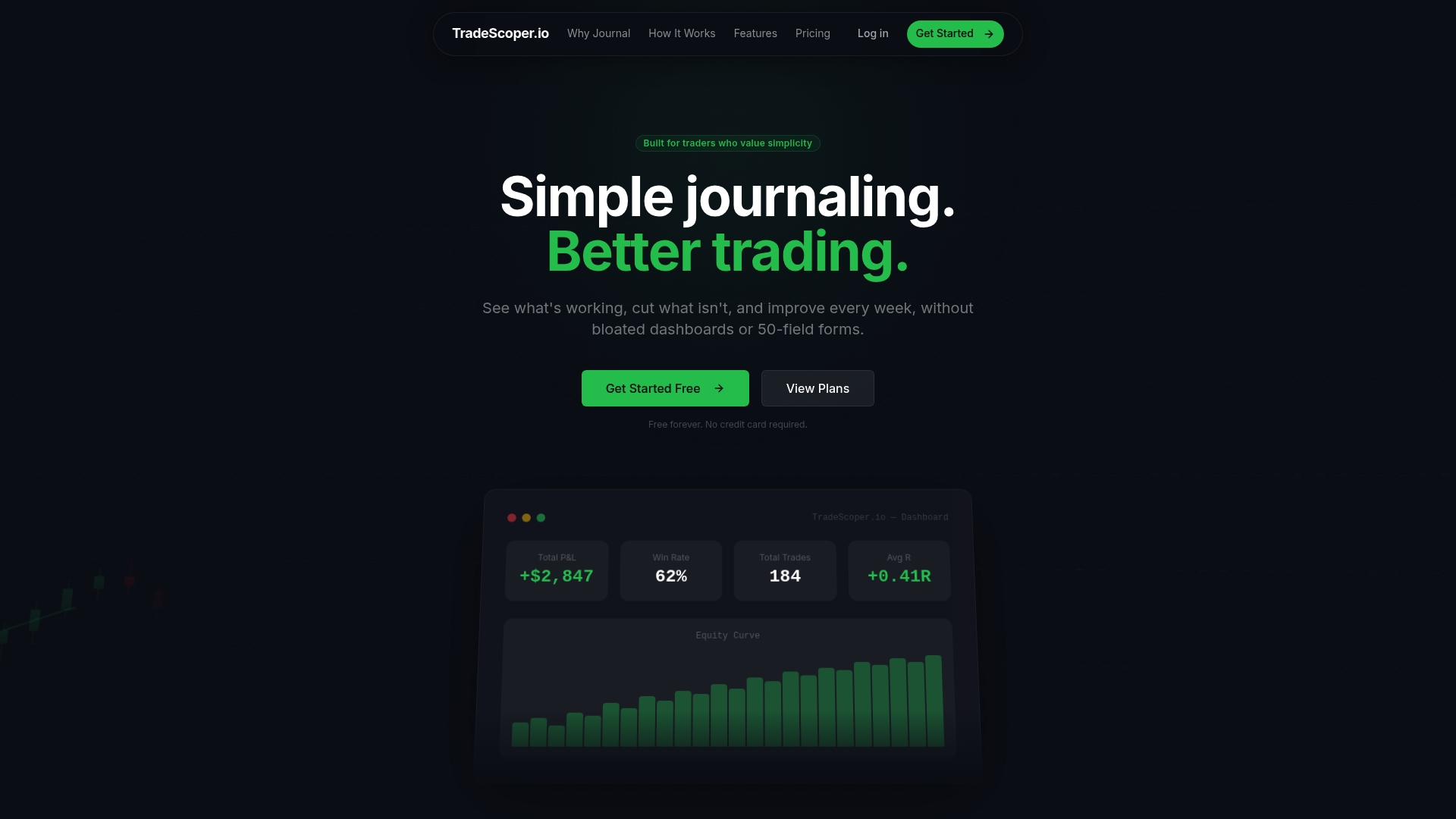
TradeScoper.io is built specifically for this. The platform combines an AI-powered trading journal with behavioral analytics and performance dashboards that make it easy to log trades, track emotional states, and identify what is actually driving your results. Whether you are managing a single forex account or running multiple strategies across markets, TradeScoper.io gives you the tools to close the gap between knowing what to do and actually doing it consistently. Start free and see what your data reveals.
Frequently asked questions
What are the main types of forex trading analysis?
Technical, fundamental, and sentiment analysis are the three main types, each offering unique insights into price movements and market behavior. Analysis approaches differ in focus, data sources, and the time horizons they are best suited for.
How does behavioral psychology impact trading performance?
Behavioral discipline, such as managing loss aversion and decision bias, is crucial for consistent trading success and avoiding common pitfall traps. Counter loss aversion by building strict risk rules into your process before you enter any trade.
Can AI and machine learning replace human analysis in forex trading?
AI and ML enhance analysis but require separate risk models and human oversight to manage unpredictable market events and psychological influences. ML aids but requires independent risk frameworks to avoid over-reliance on pattern-based signals alone.
What is the best way to start using analytical tools in forex trading?
Begin with charting platforms, economic calendars, and trading journals, and gradually incorporate behavioral tracking and risk models as your expertise grows. Consistency in logging and reviewing your trades matters more than the sophistication of the tools you start with.