TL;DR:
- Automation enhances speed and consistency but can obscure risk management weaknesses.
- Low win-rate strategies with strong risk controls can outperform high win-rate bots.
- Continuous oversight, risk safeguards, and data-driven feedback are essential for sustainable automated trading.
Automation promises to take emotion out of trading and execute strategies with machine precision. But here's the uncomfortable reality: many AI bots fail to beat a simple buy-and-hold baseline, and some high-performing strategies win only 17% of the time yet still outperform bots with 90% win rates. If you're deploying or evaluating automated systems, the gap between what automation promises and what it actually delivers is where real traders make or lose their edge. This guide cuts through the noise to show you exactly where automation adds value, where it falls short, and how to build a smarter, more resilient trading operation around it.
Table of Contents
- What automation means in trading today
- Performance realities: Automation vs. discretion
- Managing risks: Automation's safeguards and pitfalls
- Beyond execution: Analytics, emotional awareness, and strategy evolution
- Why automation's real power is not in winning trades
- Leverage advanced tools for your trading edge
- Frequently asked questions
Key Takeaways
| Point | Details |
|---|---|
| Automation is not magic | Successful trading automation requires clear understanding and does not guarantee profits. |
| Performance analysis is crucial | Sharpe, Sortino, win rate, and drawdown reveal true strategy strength beyond headline returns. |
| Risk management must be active | Automation supports advanced risk tools, but human oversight is essential for safety. |
| Hybrid methods offer adaptability | Combining automation with human judgment handles edge cases and changing market regimes. |
| Analytics drive improvement | Automated analytics and journaling help traders spot patterns, control emotions, and refine strategies. |
What automation means in trading today
Not all automation is created equal. Before you evaluate any tool or strategy, you need to know what kind of automation you're actually dealing with.
At the most basic level, rule-based bots execute predefined logic: if price crosses a moving average, buy. These are deterministic, transparent, and easy to audit. One step up, algorithmic trading systems incorporate statistical models, portfolio optimization, and dynamic position sizing. Then there are hybrid semi-automated tools, which handle execution and data processing but leave key decisions to the trader. Finally, multi-agent AI systems use machine learning ensembles to adapt in real time, though they introduce significant complexity and opacity.
Here's what automation does well, and where it struggles:
- Emotionless execution: No hesitation, no revenge trading, no second-guessing at 3 a.m.
- Speed and scalability: Bots can monitor dozens of instruments simultaneously and react in milliseconds.
- Backtesting edge: Automated systems show Sharpe ratios of 1.8 vs. 1.1 for discretionary strategies in controlled tests.
- Technical fragility: HFT systems can amplify losses in flash crashes and unexpected liquidity gaps.
- Crowding risk: When too many bots run similar strategies, edges erode fast.
- Retail vs. institutional gap: Retail automation tools rarely match the infrastructure advantages of institutional players.
"Automation doesn't remove risk. It shifts who manages it and when."
A common misconception is that more automation equals more profit. In reality, automation shifts the burden from real-time decision-making to system design and ongoing oversight. If your system design is flawed, automation just executes those flaws faster. Understanding automation in your trading workflow means knowing exactly which decisions you're delegating and which you're keeping.
Pro Tip: Before deploying any automated tool, ask specifically: is this rule-based, model-driven, or AI-adaptive? Each type requires a different oversight approach and carries different failure modes. Treat automated trading analysis as an ongoing process, not a one-time setup.
Performance realities: Automation vs. discretion
The performance data on automated trading is genuinely surprising, and not always in the direction you'd expect.
In structured competitions and live deployments, AI bots have shown annualized returns ranging from 43% to 362%, with some achieving Sharpe ratios above 2 and win rates between 70% and 85%. That sounds extraordinary. But the same research shows many large language model-based systems fail to beat a basic buy-and-hold strategy when tested on real market data. The headline numbers are real but not representative.

One of the most counterintuitive findings: a low win-rate strategy at 17% outperformed a 90% win-rate bot in competition conditions. Why? Because the low win-rate system used superior risk management that captured large, asymmetric gains while keeping losses small. Fat tails, those rare but massive market moves, were what separated the winners.
| Metric | Automated systems | Discretionary trading |
|---|---|---|
| Sharpe ratio | Up to 2.1 (top bots) | ~1.1 average |
| Win rate | 17% to 90% (varies widely) | 45% to 60% typical |
| Max drawdown | 11% (well-configured) | 15% to 30% |
| Adaptability | Low in novel conditions | High |
| Scalability | Very high | Limited by attention |
Discretionary traders consistently outperform in illiquid markets, during macro surprises, and in situations where context matters more than pattern. A bot doesn't know that a central bank governor just changed their tone mid-press conference. A skilled discretionary trader does.
The key takeaways:
- Don't benchmark against win rate alone. A 60% win rate with poor risk management destroys accounts.
- Drawdown control is the real differentiator. Live bots achieving 47% ROI with 11% drawdown beat the S&P on a risk-adjusted basis.
- Backtest results rarely survive live deployment. Slippage, latency, and regime changes all compress real returns.
- LLM-based systems need fine-tuning. General-purpose AI models lack the trading-specific calibration to outperform even basic strategies.
Using a solid performance dashboard to track these metrics in real time is not optional. It's how you catch strategy drift before it becomes a drawdown. Pair that with automated performance analysis and you move from reactive to proactive management.
Managing risks: Automation's safeguards and pitfalls
Automation introduces a unique risk profile that most traders underestimate until it's too late. The good news: there are proven safeguards. The bad news: they only work if you actually implement and test them.
| Risk tool | What it does | Recommended setting |
|---|---|---|
| Volatility targeting | Scales position size to current market volatility | Adjust daily or weekly |
| Dynamic position sizing | Limits risk per trade | 1% to 2% of account per trade |
| Kill switch | Halts all trading on trigger | Activate on 3+ consecutive losses |
| Max drawdown limit | Stops system at threshold | 15% to 20% of account |
| Circuit breaker | Pauses trading during extreme moves | News events, VIX spikes |
| News filter | Avoids trading around high-impact releases | 30 minutes pre/post release |
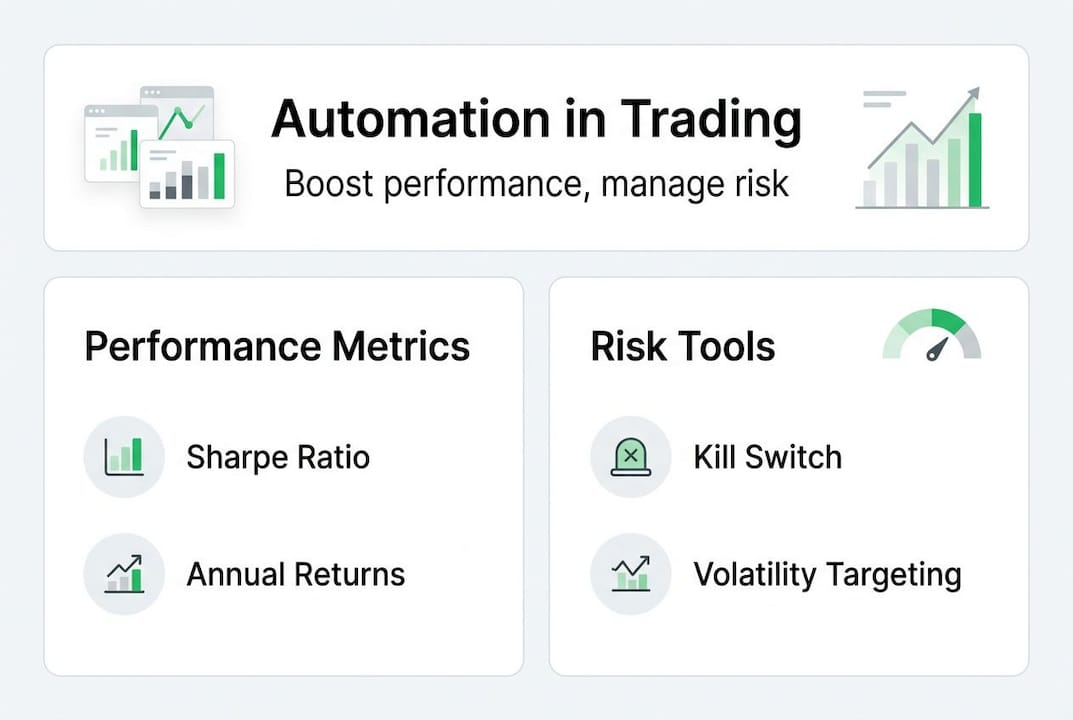
These tools, when properly configured, form a layered defense. Volatility targeting, kill switches, and circuit breakers are not optional add-ons. They are the difference between a controlled drawdown and an account wipeout.
Here's how to build reliable drawdown management into your automated system:
- Define your maximum acceptable drawdown before you go live. This is your hard stop, not a suggestion.
- Code your kill switch logic to trigger at 50% of your max drawdown threshold, giving you time to review before things get critical.
- Backtest your risk parameters across multiple market regimes, including 2020-style volatility spikes.
- Run a live-sim environment for at least two weeks before deploying real capital. Test every safeguard under realistic conditions.
- Schedule weekly reviews of your system's behavior, not just its P&L.
Pro Tip: Never assume your kill switch works just because it's coded. Test it explicitly in a live-sim environment with forced trigger conditions. Untested safeguards are the same as no safeguards.
Blind reliance on automation is one of the fastest ways to blow an account. Human oversight is not a weakness in your system. It's a required layer. Reviewing day trading risk strategies alongside your automated setup gives you the broader context your bot simply cannot process.
Beyond execution: Analytics, emotional awareness, and strategy evolution
The traders who get the most from automation are not the ones chasing the highest-return bot. They're the ones using automation to build a feedback loop that makes them better over time.
Automated journaling is one of the most underused tools in active trading. When your system logs every trade with entry, exit, P&L, and market conditions, you start to see patterns that are invisible in the moment. Regime detection, identifying whether you're in a trending, ranging, or volatile market, allows your system to switch strategies automatically rather than applying one approach to every condition.
"The traders who win long-term are not those with the best bot. They're those who understand what their data is telling them."
Here's what to track for meaningful strategy evolution:
- Sharpe ratio trends: A declining Sharpe over rolling 30-day windows signals strategy decay before your P&L does.
- Sortino ratio: Unlike Sharpe, Sortino only penalizes downside volatility, giving a cleaner picture of risk-adjusted performance.
- Win rate by session and instrument: You may be profitable in London session forex but losing in U.S. equity opens. Automation surfaces this.
- Emotional state correlation: Automated journaling and regime detection let you connect your emotional state at trade entry to outcomes, revealing behavioral patterns that cost you money.
- Strategy drift detection: When your system's behavior deviates from its backtest profile, something in the market has changed.
Hybrid approaches preserve your adaptability in edge cases. A bot can handle routine setups while you focus on the high-conviction, low-frequency trades that require genuine judgment. Understanding trade logging benefits is the foundation here. Without consistent data, your performance analytics tools have nothing meaningful to analyze. Explore the full range of automation tools available to build this feedback loop into your daily workflow.
Pro Tip: Set up automated journaling to capture not just trade data but your pre-trade mindset. Even a simple 1-5 confidence rating per trade reveals patterns in how emotional state affects your results over time.
Why automation's real power is not in winning trades
Most traders approach automation as a profit machine. That's the wrong frame entirely.
The real value of automation is in process consistency, behavioral feedback, and incremental improvement. When you automate your logging, analytics, and execution rules, you remove the variability that makes it impossible to know whether your results reflect skill or luck. You create a system you can actually learn from.
Multi-agent AI ensembles and evolutionary frameworks like QuantEvolve exist precisely because single-model systems carry blind spots that only diverse approaches can address. Even the best automated systems need regular human review and strategy tuning. The market is not static, and neither should your system be.
The traders who burn out on automation are those who set it and forget it. The ones who build lasting edges are those who treat their automated system as a tool for reinforcing discipline and validating incremental improvements, not as a replacement for thinking.
Pro Tip: Review your automated system's performance weekly, not just when something goes wrong. Consistent small adjustments outperform reactive overhauls every time.
Leverage advanced tools for your trading edge
You now understand where automation genuinely adds value and where it needs your oversight. The next step is putting the right tools in place to make that happen.
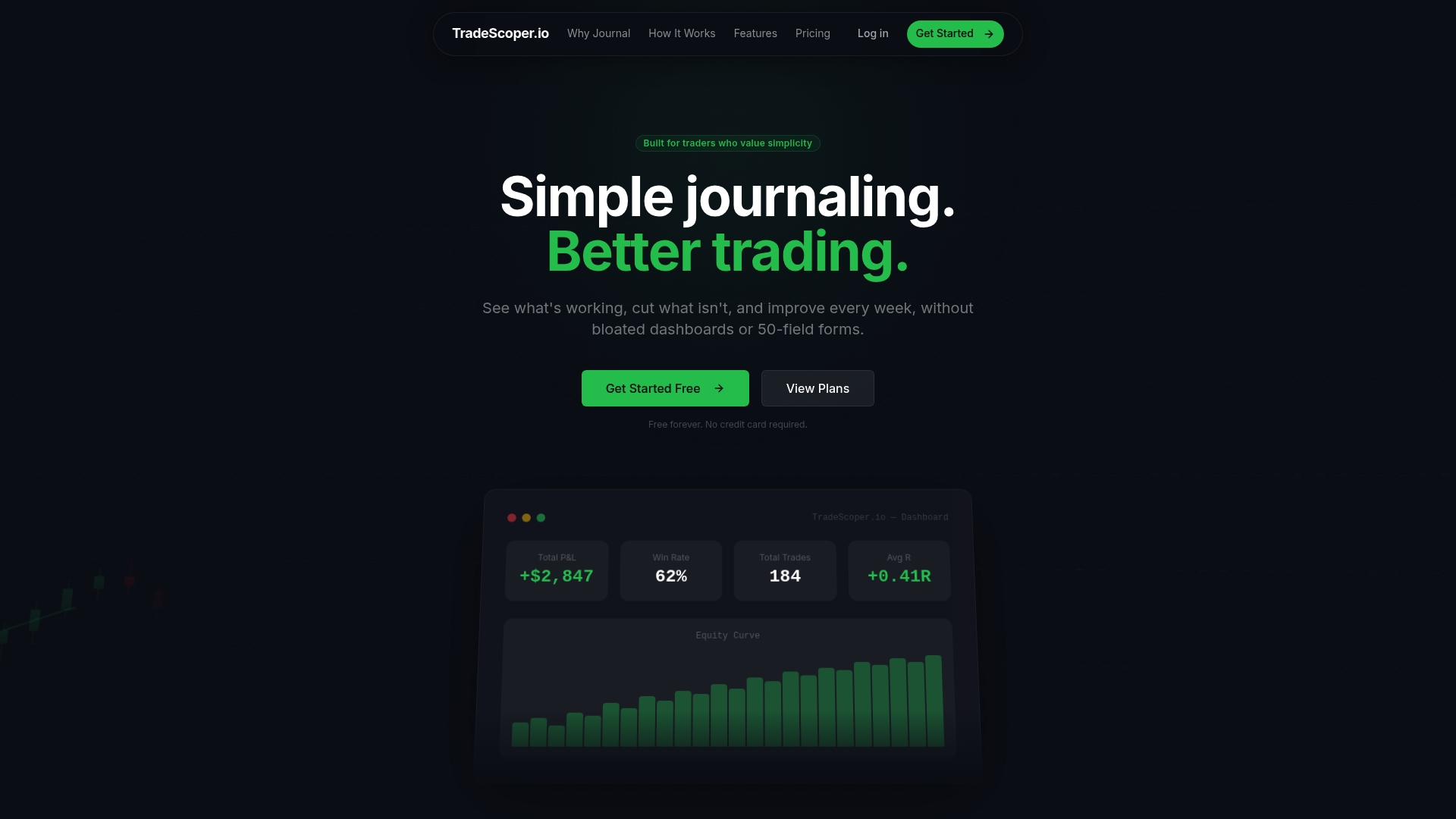
TradeScoper.io gives active traders a purpose-built environment to track, analyze, and improve performance without the complexity of bloated platforms. The performance dashboard delivers real-time Sharpe, Sortino, and drawdown analytics across all your accounts. The AI trading journal automates your logging and surfaces behavioral patterns that affect your results. And the AI analyzer identifies strategy drift and pattern breakdowns before they become costly. Whether you're running a fully automated system or a hybrid approach, TradeScoper.io gives you the data layer your trading operation needs.
Frequently asked questions
Can trading automation guarantee profits?
No, automation increases consistency and removes emotional execution errors, but AI underperforms baselines in many benchmarks and cannot eliminate inherent market risk.
How do automated trading bots handle volatile markets?
Modern bots use volatility targeting, kill switches, and circuit breakers to scale down exposure and pause trading during extreme conditions, limiting drawdowns.
What metrics matter most when evaluating trading automation?
Sharpe and Sortino ratios alongside maximum drawdown give you the clearest picture of risk-adjusted performance, far more than win rate alone.
Why do some automated strategies with low win rates outperform high win-rate bots?
Low win-rate strategies often use asymmetric risk management that captures large gains on rare moves while keeping individual losses small, which is why 17% win-rate strategies can outperform 90% win-rate systems.
Is hybrid trading better than full automation?
In complex or illiquid markets, hybrid semi-automated trading typically outperforms full automation by preserving human adaptability for edge cases that bots are not designed to handle.
Recommended
- Automated trading analysis: boost performance & cut risk
- Streamline your day trading workflow: steps and tools | TradeScoper.io
- Blog | TradeScoper.io
- Trade logging explained: boost consistency by 73%
- How to Automate Trade Execution for Proven Results - My Framer Site
- How to optimize trading workflow: Forex, CFDs & crypto