
TL;DR:
- Most day traders fail due to lack of structured routines and risk management.
- Successful trading relies on disciplined preparation, execution, review, and emotional awareness.
- Only 1.6% of day traders are consistently profitable, emphasizing process over strategy.
Most day traders fail not because they lack skill, but because they lack structure. 80% of day traders quit within two years, and poor planning is the leading cause. The gap between a trader who survives and one who burns out usually comes down to workflow, not talent. This guide walks you through every stage of a high-performance trading routine, from pre-market prep to post-session review, with practical tools and strategies built for day traders and swing traders who want consistent, repeatable results.
Table of Contents
- Establishing your trading prerequisites and routines
- Step-by-step: Executing the core day trading workflow
- Performance tracking and post-market review
- Building emotional awareness and discipline
- The uncomfortable truth most traders won't admit
- Enhance your workflow with AI trading journals
- Frequently asked questions
Key Takeaways
| Point | Details |
|---|---|
| Routine is critical | Pre-market, live trading, and post-market reviews build consistent results. |
| Risk management first | Limiting risk to 1-2% per trade prevents catastrophic losses. |
| Track your performance | Use trade journals and analytics to spot patterns and refine your strategy. |
| Mind your psychology | Emotional awareness and discipline are the foundation of trading longevity. |
| Swing trading fits most | For part-timers, swing trading offers lower stress and better odds. |
Establishing your trading prerequisites and routines
Before you place a single trade, you need the right foundation. That means adequate capital, a reliable computer with a fast internet connection, and access to a reputable broker and charting platform. Without these basics locked in, even the best strategy falls apart under execution pressure.
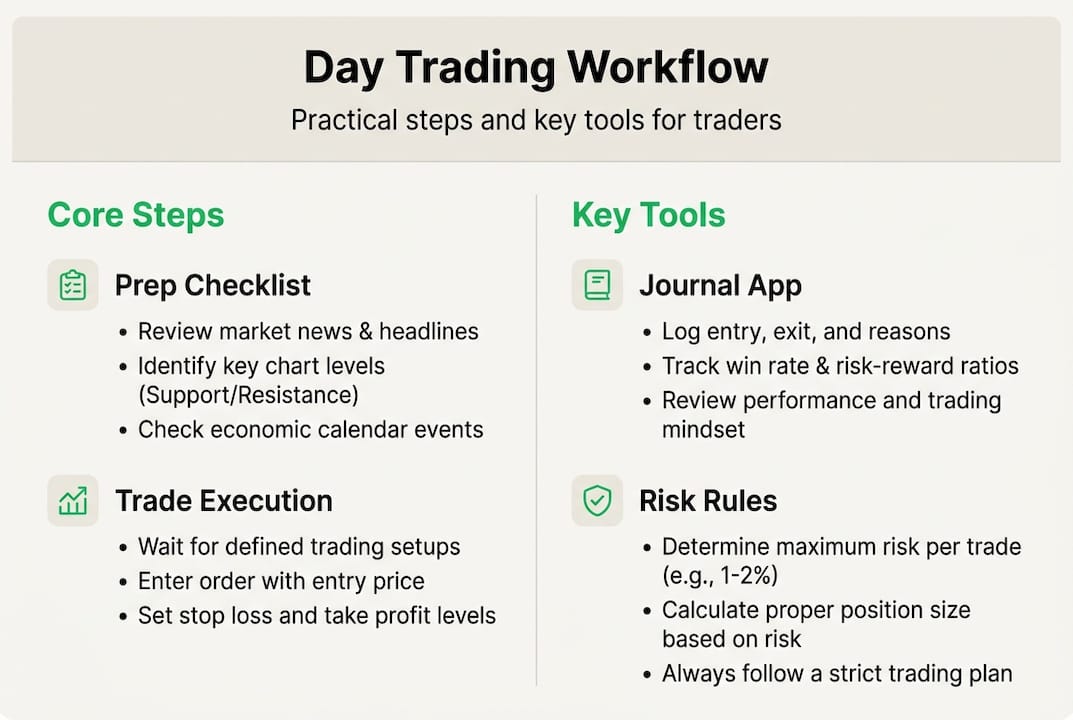
Pre-market preparation is not optional. Pre-market prep takes 1 to 3 hours and directly shapes your performance for the session. During this window, you should scan global news, identify catalysts like earnings reports or economic data releases, and build a focused watchlist. Trying to skip this step is like showing up to a chess match without studying the board.
Swing trading has a different rhythm. While day traders are glued to their screens for hours, swing traders hold positions for days or weeks. If you want to compare time commitments and stress levels side by side, a swing trading workflow comparison breaks down the key differences clearly. Swing trading suits traders who want lower intensity without sacrificing opportunity.
Here is a quick overview of the core tools you need:
| Tool | Purpose | Example |
|---|---|---|
| Charting software | Technical analysis | TradingView, Thinkorswim |
| Stock scanner | Identify setups | Finviz, Trade Ideas |
| Trade journal | Log and review trades | TradeScoper.io |
| News feed | Track catalysts | Benzinga Pro, Bloomberg |
| Broker platform | Order execution | Interactive Brokers, Webull |
Key items to check before market open:
- Review overnight news and global market moves
- Identify high-volume, high-momentum candidates
- Mark key support and resistance levels on your charts
- Set alerts for your top watchlist stocks
- Confirm your risk parameters for the day
Pro Tip: Build a written pre-market checklist and run through it every single morning. It prevents tunnel vision and keeps you from chasing random setups that were never part of your plan.
Step-by-step: Executing the core day trading workflow
With your pre-market routine locked in, it is time to trade with precision. The live trading phase is where preparation meets execution, and where most traders either follow their plan or abandon it under pressure.
Day trading uses 1 to 5 minute charts for live execution, which means decisions happen fast. Every trade should pass a five-step test before you pull the trigger:
- Setup: Does the chart pattern match a strategy you have tested?
- Trigger: Is there a clear entry signal, like a breakout or pullback?
- Stop-loss: Where exactly will you exit if the trade goes against you?
- Profit target: What is your realistic exit for a winning trade?
- Risk/reward: Is the potential reward at least twice the risk?
If a trade fails any of these five checks, skip it. There will always be another setup.
Risk management is the engine that keeps you in the game. Most professional traders risk 1 to 2% per trade to protect their capital during losing streaks. Position sizing is not exciting, but it is the single most important discipline you can build. Overtrading is the fastest way to blow an account, and it usually happens when traders try to recover losses in the same session.

Here is how day trading and swing trading execution compare:
| Factor | Day trading | Swing trading |
|---|---|---|
| Trade duration | Minutes to hours | Days to weeks |
| Charts used | 1 to 5 minute | Daily, 4-hour |
| Trades per week | 10 to 50+ | 2 to 10 |
| Overnight risk | None | Present |
| Time required | Full-time | 30 to 60 minutes daily |
"The goal of a successful trader is not to make the most trades. It is to make the right ones."
Pro Tip: Set a timer for 10 to 15 minutes after entering a trade. Step away from the screen. Constant monitoring triggers emotional decisions that your original plan never accounted for. Use logging trade outcomes to record each result immediately after closing.
Performance tracking and post-market review
Once you have executed trades, the real work begins. Most traders skip the post-market review, and that is exactly why they keep repeating the same mistakes. Reviewing your session is not optional if you want to improve.
A proper performance review covers several key metrics:
- Win rate: What percentage of your trades closed profitably?
- R-multiples: Did you earn more than you risked on winning trades?
- Max drawdown: What was the largest peak-to-trough loss in a session?
- Average trade duration: Are you holding too long or cutting winners too early?
- Behavior tags: Were any trades driven by FOMO, boredom, or revenge?
Trade journals are essential for logging, analytics, and identifying your real edge. Top platforms like TradeZella, TraderSync, TradesViz, and Edgewonk each offer broker integration, replay features, and detailed reporting. TradeZella, for example, provides over 50 performance reports and coaching insights that help you spot patterns you would never catch manually.
The statistics here are sobering. 90 to 97% of day traders lose money over the long term. The traders who survive are not necessarily more talented. They are more systematic. They track every trade, tag every emotional decision, and use data to eliminate weak spots in their process.
Behavior tagging is one of the most underused features in trade journals. Tagging a trade as "revenge trade" or "FOMO entry" creates a data trail that reveals your most costly patterns. Over time, you can see exactly which emotional triggers cost you the most money.
Pro Tip: Spend at least 20 minutes after every session reviewing your trades in your journal. Use logging post-market reviews to track patterns across weeks and months, not just individual days. Patterns only become visible with consistent data.
Building emotional awareness and discipline
Performance data points directly to your psychology. Once you see the numbers, you cannot ignore the emotional patterns behind them. Trading psychology is not soft advice. It is the foundation everything else is built on.
Trading success is 80% psychology and only 20% strategy. That ratio surprises most new traders, but experienced traders know it is accurate. You can have a statistically sound strategy and still lose money consistently if your emotional responses override your rules.
Common psychological pitfalls to watch for:
- FOMO (fear of missing out): Chasing trades that already moved without your entry signal
- Revenge trading: Trying to recover losses immediately after a bad trade
- Overconfidence: Increasing position size after a winning streak without adjusting risk
- Paralysis: Hesitating on valid setups because of recent losses
- Ignoring stop-losses: Moving stops to avoid taking a loss
Building a daily discipline routine is what separates traders who last from those who quit. A strong morning routine includes breathing exercises to reduce cortisol, written goal setting for the session, and a quick review of yesterday's mistakes before you open any charts. These habits take less than ten minutes but dramatically reduce impulsive decisions.
"Discipline and consistency matter more than profits. Profits are the result, not the goal."
Use journaling for discipline to write down your emotional state before and after each session. Over time, you will recognize the conditions under which you trade your best and worst. That self-awareness is worth more than any indicator.
Pro Tip: Set a phone reminder at the midpoint of your trading session for a 5-minute self-check-in. Ask yourself: Am I following my plan? Am I trading out of emotion? One honest question can prevent a costly mistake.
The uncomfortable truth most traders won't admit
Here is what the data actually says: only 1.6% of day traders are consistently profitable on an annual basis. That is not a motivation problem or a strategy problem. It is a process problem.
Most traders spend years chasing better setups, better indicators, and better entry signals. They never fix the real issue, which is the absence of a repeatable, documented process. Journaling key insights at TradeScoper.io is not glamorous, but it is what separates the 1.6% from everyone else.
Swing trading also deserves more credit than it gets in retail trading communities. For most people with full-time jobs or family responsibilities, day trading is genuinely unsustainable. The stress, screen time, and emotional load are enormous. Swing trading offers comparable opportunity with far less burnout risk. The traders we see succeed long-term are often the ones who matched their strategy to their actual lifestyle, not the lifestyle they imagined.
Survival comes before profit. Process is paramount. If you are not tracking, reviewing, and adjusting, you are not trading. You are gambling with extra steps.
Enhance your workflow with AI trading journals
Putting all of these workflow strategies into practice is much easier when you have the right tools behind you. TradeScoper.io was built specifically for traders who want fast, clean performance tracking without the clutter of overcomplicated dashboards.
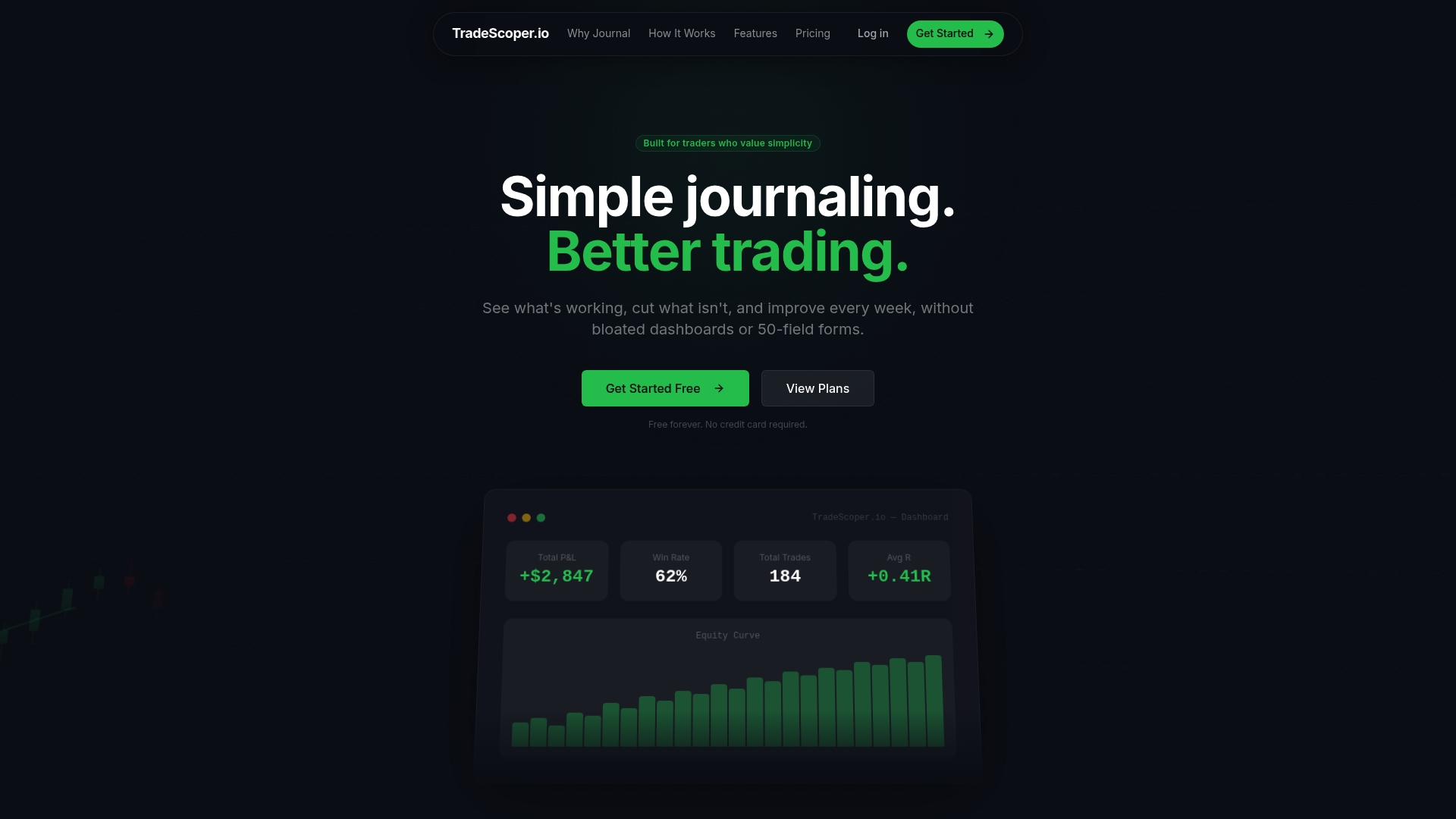
With an AI-powered trading journal, you can log trades in seconds, tag emotional states, and get pattern analysis that shows you exactly where your edge is strongest and where it breaks down. Whether you are a day trader reviewing five-minute charts or a swing trader managing multi-day positions, TradeScoper.io gives you the behavioral and statistical insights to trade smarter. Start free and scale as your performance grows.
Frequently asked questions
What is the most effective day trading workflow?
A structured routine with pre-market prep, disciplined live execution, and a post-market review that includes journaling and risk analysis consistently produces the best long-term results.
Which performance tracking tool is best for day traders?
TradeZella offers 50+ reports and coaching insights, making it one of the top-rated options alongside TraderSync and TradesViz for broker integration and trade replay features.
How much time should you spend on day trading routines?
Day trading demands 7 to 9 hours daily, while swing trading requires 30 to 60 minutes, making it far more compatible with part-time schedules or full-time employment.
What psychological mistakes cause traders to fail?
Psychology drives 80% of failures, with overtrading, revenge trading, and ignoring stop-losses being the most common and costly patterns traders repeat without proper journaling.