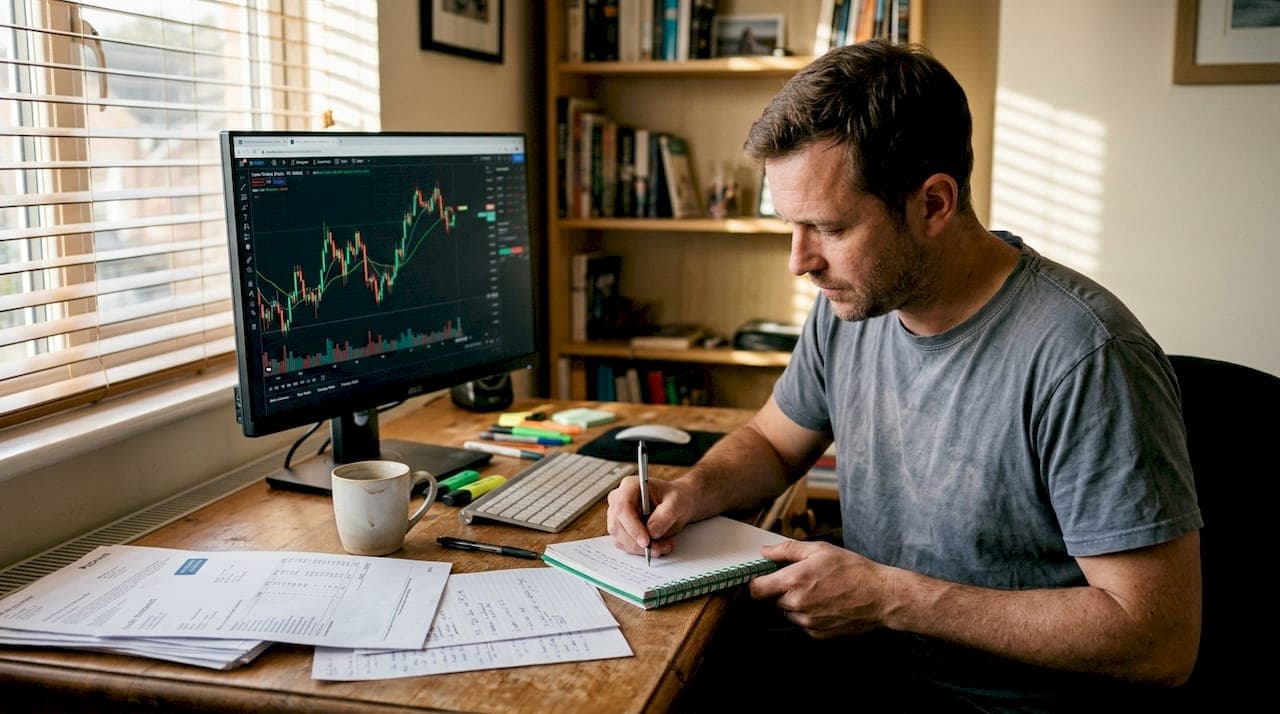
Most traders believe they remember their best and worst trades clearly. They don't. Memory is selective, emotions distort recall, and gut feel is not a strategy. A trade journal eliminates memory bias by giving you a factual record of every entry, exit, and decision you made. This article breaks down what trade tracking actually is, why it matters more than most traders realize, which metrics it unlocks, and how to build a journaling habit that directly improves your consistency and profitability.
Table of Contents
- What does it mean to track your forex trades?
- Top reasons you should track every forex trade
- The key performance metrics trade tracking unlocks
- From hobbyist to pro: Advanced trade tracking techniques
- Real-world proof: Journaling's impact on trader performance
- How to get started: Simple steps to effective trade journaling
- Upgrade your trading results with smarter journaling
- Frequently asked questions
Key Takeaways
| Point | Details |
|---|---|
| Reduce bias | A trading journal replaces faulty memory and emotional bias with objective data. |
| Spot strengths and weaknesses | Tracking lets you discover your best setups and costly mistakes for targeted improvement. |
| Measure true performance | Key metrics like expectancy and win rate show if your strategy really works. |
| Level up discipline | Consistent journaling develops better trading habits and encourages sticking to your plan. |
| Easy start, pro payoff | Even simple tracking boosts results, and advanced journaling unlocks professional-grade insights. |
What does it mean to track your forex trades?
Tracking your trades is not the same as keeping a list of wins and losses. A list tells you what happened. A structured journal tells you why it happened and what to do differently next time. That distinction is everything.
Professional trade tracking means recording a specific set of data points for every single trade, not just the ones that feel worth remembering. The core elements you need to capture include:
- Entry and exit prices with timestamps
- Setup type and the market conditions that triggered your entry
- Position size and the risk you accepted in dollar terms
- Trade rationale written before or at the moment of entry
- Emotional state before, during, and after the trade
- Result in both pips and dollars
"Journaling enforces discipline by requiring documentation of trade rationale, emotions, and adherence to plan, reducing impulsive emotional trading."
The discipline benefit here is real. When you know you have to write down your reasoning, you think twice before taking a low-quality setup. That forced review alone cuts impulsive trades. You can start with a notebook, move to a spreadsheet, or use simple trading journal features built specifically for forex traders. The format matters less than the consistency.
Top reasons you should track every forex trade
With a clear understanding of what trade tracking is, let's look at the compelling reasons why it should be your top trading habit.
Tracking every trade delivers benefits that compound over time. Here are the most important ones:
- Eliminate selective memory. You naturally remember your winners more vividly than your losers. A journal corrects that distortion with raw data.
- Discover real patterns. You might think you trade best on Tuesdays during the London session. Your journal will confirm or destroy that assumption with actual numbers.
- Calculate your true win rate and expectancy. These numbers tell you whether your strategy is viable, not your feelings about last week.
- Build evidence for strategy changes. Instead of tweaking your approach based on a bad streak, you make changes based on statistically meaningful sample sizes.
- Reduce emotional trading. Accountability to your own written record is a powerful brake on revenge trading and overtrading.
A historical record of past performance lets you calculate key metrics like win rate, expectancy, R-multiple distribution, and drawdown with precision.
These benefits are not theoretical. Traders who use journals to support discipline consistently outperform those who rely on memory and instinct alone. The data is the edge.
The key performance metrics trade tracking unlocks
Knowing the major benefits, let's break down exactly what you can measure and why these numbers matter.
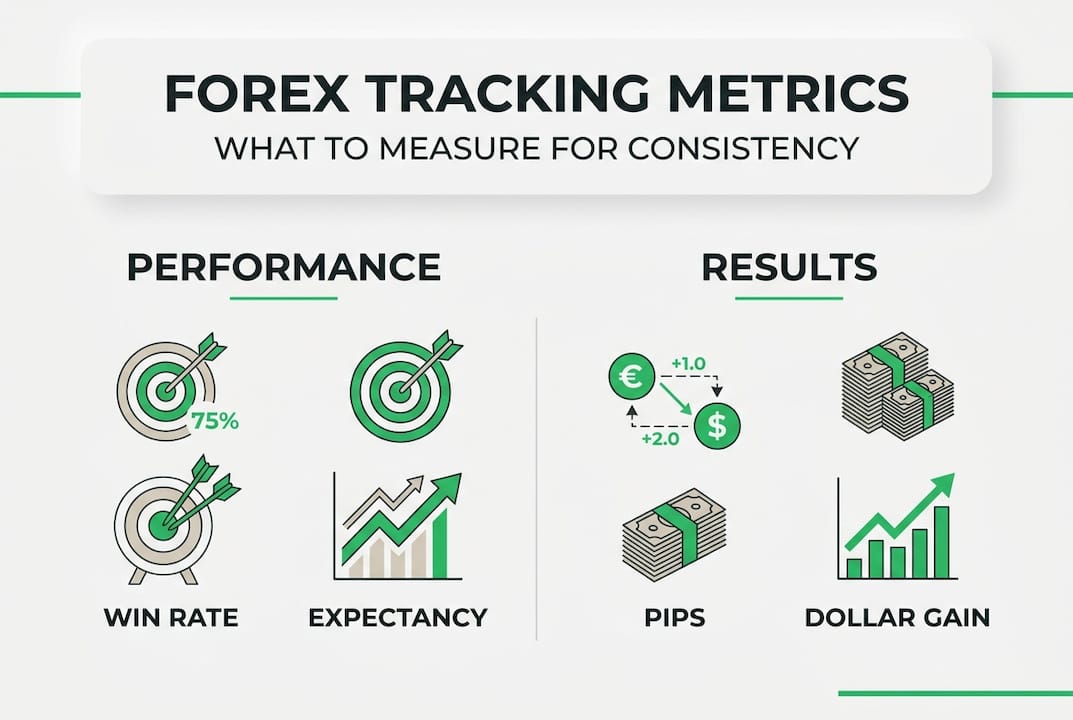
Here are the four metrics every forex trader should track:
| Metric | Formula | What it reveals |
|---|---|---|
| Win rate | Wins / Total trades | How often your setups succeed |
| Expectancy | (Win rate x Avg win) minus (Loss rate x Avg loss) | Whether your strategy makes money over time |
| R-multiple | Result / Initial risk | Quality of each trade relative to what you risked |
| Drawdown | Peak to trough equity drop | How much pain your strategy inflicts before recovering |
Expectancy is the most underused of these. A strategy with a 40% win rate can still be highly profitable if your average winner is 2.5R and your average loser is 1R. Most traders never calculate this because they don't track the data needed to do so.
Tracking both pips and dollar results matters too. Pips versus dollar tracking reveals whether a strategy is genuinely strong or just benefiting from oversized position sizing. Those are very different problems with very different solutions.
Pro Tip: Review your metrics weekly, not daily. Daily reviews create noise and emotional reactions to short-term variance. Weekly reviews reveal meaningful trends. Use automated MT4/5 journaling to pull data automatically and spend your review time analyzing, not entering numbers.
From hobbyist to pro: Advanced trade tracking techniques
If you want to step up your trading, consider how professionals expand their tracking far beyond the basics.
Once you have the fundamentals locked in, advanced tracking opens up a new layer of insight. Professionals go beyond entry and exit data to capture:
- Slippage per trade to identify execution quality issues with specific brokers or sessions
- Hold time to understand whether your edge is in quick scalps or longer swing setups
- Volatility regime at the time of entry, so you know if your strategy performs differently in trending versus ranging markets
- Session performance broken down by London, New York, and Asian opens
Walk-forward analysis uses your journal data to test whether a strategy holds up on new data, protecting you from overfitting your rules to past results.
One of the most important shifts professionals make is focusing on equity curve smoothness rather than raw profit and loss. A strategy that returns 30% with a smooth, consistent equity curve is far more tradeable than one that returns 40% with violent swings. Your journal data is what lets you see that difference clearly.
Pro Tip: Automate your data capture wherever possible. Manual entry creates gaps and errors. Professional journaling techniques that connect directly to your trading platform give you cleaner data and more time to focus on analysis.
Real-world proof: Journaling's impact on trader performance
The most convincing evidence comes from real traders. Here's what the data shows when trade journaling is applied consistently.
One documented case study shows a trader who grew a $3,000 account to $23,000 in a single year. The method was not a new indicator or a secret strategy. It was systematic journaling and session analysis, combined with one critical decision: cutting all countertrend trades after the data revealed they were consistently losing.
Here's a simplified before-and-after view of that trader's key results:
| Metric | Before journaling | After journaling |
|---|---|---|
| Win rate | 38% | 54% |
| Expectancy | Negative | Positive |
| Countertrend trades | Frequent | Eliminated |
| Account growth | Stagnant | $3k to $23k |
The shift to positive expectancy came not from finding a better strategy, but from understanding which parts of an existing strategy were working and which were destroying the edge.
This is the core promise of trade tracking. You don't need a new system. You need clarity on the one you already have. Explore journaling success stories to see how other traders have applied this same process.
How to get started: Simple steps to effective trade journaling
Ready to apply these lessons? Here's how to integrate tracking into your routine without overwhelm.
Getting started is simpler than most traders expect. Follow these steps:
- Choose your tool. A notebook works. A spreadsheet works better. An automated app works best. Pick the one you will actually use consistently.
- Define your minimum data set. At a minimum, record entry price, exit price, setup type, risk in dollars, and your emotional state. Don't try to track 20 fields on day one.
- Write your rationale before entry. This single habit eliminates most impulsive trades. If you can't write a clear reason, you probably shouldn't take the trade.
- Schedule a weekly review. Block 30 minutes every Sunday or Monday. Look at your metrics, identify one pattern, and set one intention for the coming week.
- Iterate over time. Add new data fields as you identify gaps. Regular review and improvement is what separates traders who grow from those who stay stuck.
Pro Tip: Start with easy journaling steps and resist the urge to build the perfect system on day one. A simple journal you use every day beats a complex one you abandon after a week.
Consistency is the only requirement. The insights follow naturally once the data starts accumulating.
Upgrade your trading results with smarter journaling
If you're serious about turning your trade data into real performance gains, the right tool makes all the difference. TradeScoper.io is built specifically for forex traders who want the benefits of professional journaling without the friction of manual spreadsheets or clunky interfaces.
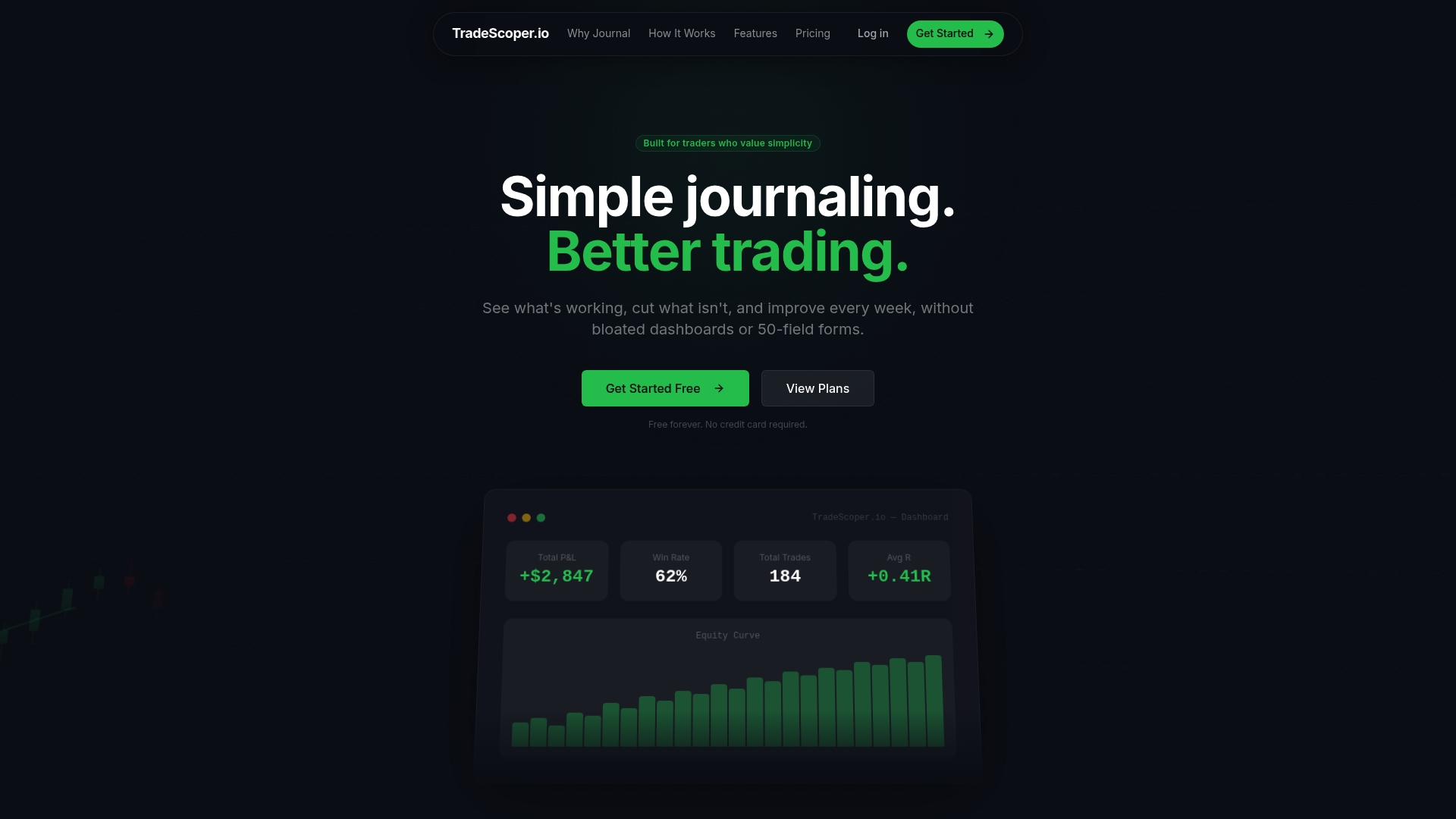
With TradeScoper's smart journal, you can log trades in seconds, track emotional states alongside your metrics, and let AI-powered pattern analysis surface insights you'd never spot manually. The platform handles the data work so you can focus on what matters: understanding your edge and trading it consistently. Whether you're managing a single account or running multiple strategies, TradeScoper.io scales with your needs. Start free and see what your data has been trying to tell you.
Frequently asked questions
What is the most important information to record in a forex trading journal?
Record entry and exit points, trade rationale, position size, emotional state, and results. These fields give you the full picture needed to reduce impulsive trading and improve over time.
How does tracking forex trades improve profitability?
Tracking reveals which setups, sessions, and behaviors are helping or hurting your results. Traders who journal consistently can make targeted changes, as shown by one trader who grew $3k to $23k in a year through journaling alone.
Do professional traders use trading journals?
Yes. Professionals track advanced data points like slippage, hold times, and volatility regimes, and they focus on equity curve smoothness rather than just raw profit to evaluate strategy quality.
Can I use spreadsheets or do I need a special app to track trades?
Spreadsheets work, but automated MT4/5 journals offer better consistency, reduce manual errors, and make metric tracking far easier as your trade volume grows.