TL;DR:
- AI trading excels in stable markets with predictable patterns, like some equities and forex.
- Most retail AI bots underperform simple buy-and-hold strategies within a year.
- A hybrid approach, combining AI tools with human judgment, is the most effective trading strategy.
AI trading tools are everywhere in 2026, and the promises are bold: better returns, faster execution, and an edge that retail traders have never had before. But 47% of AI accounts underperform a simple buy-and-hold strategy. That gap between the hype and the hard data is exactly what most guides skip over. This article cuts through the noise to give you an honest, research-backed look at when AI genuinely helps your trading, where it falls short, and how to build a setup that actually works. Whether you trade forex, indices, or crypto, you'll leave with a clearer picture of how to use AI as a tool, not a crutch.
Table of Contents
- How AI is changing modern trading
- The real performance data: Where AI excels and falls short
- AI plus human: Why hybrid approaches outperform pure automation
- Risks, costs, and must-know pitfalls of AI trading
- The real edge: Mastering both human and machine for trading success
- Ready to make smarter trading decisions with AI?
- Frequently asked questions
Key Takeaways
| Point | Details |
|---|---|
| AI excels in specific markets | AI is most effective in environments with stable, repeatable patterns like certain equities and forex. |
| No guaranteed outperformance | Empirical evidence shows many AI trading accounts underperform simple buy-and-hold strategies. |
| Hybrid beats automation | Combining human judgment with AI delivers better trading outcomes than relying purely on automation. |
| Watch for hidden risks | Pattern decay, slippage, and regulatory factors are crucial and can erode AI-generated returns. |
| Routine review is key | Ongoing monitoring and adaptation of AI models and strategies are essential for success. |
How AI is changing modern trading
AI has fundamentally shifted what's possible for individual traders. Tasks that once required a team of quants at a hedge fund, like scanning hundreds of instruments simultaneously, detecting subtle price patterns, and executing orders in milliseconds, are now accessible through retail platforms. That's a genuine democratization of capability.
At its core, AI trading relies on a few key strengths:
- Speed: AI executes and monitors trades far faster than any human, capturing fleeting opportunities in volatile sessions.
- Pattern recognition: Machine learning models identify statistical regularities in price data that human eyes miss.
- 24/7 monitoring: AI doesn't sleep, which matters enormously in crypto and global forex markets that never close.
- Emotionless execution: AI sticks to its rules, eliminating impulsive decisions driven by fear or greed.
These advantages are real, and the research backs them up. LSTM models outperform traditional models in Indian equities, while ALFA generates 8.79% to 19% annual returns in forex simulations. That's not trivial. It shows that in the right market conditions, AI-driven strategies can produce meaningful edges.
For practical applications, trading analysis automation has become one of the fastest-growing areas in retail trading. Traders are using AI to generate signals, backtest strategies across years of data in seconds, and flag when their usual setups are forming. The technology also applies across asset classes. Forex pairs with predictable macroeconomic cycles, equity indices with seasonal patterns, and even certain crypto tokens with high liquidity all present opportunities for AI-based analysis.
| AI capability | Benefit for traders | Asset class fit |
|---|---|---|
| Pattern recognition | Finds high-probability setups | Forex, equities |
| Speed of execution | Reduces slippage on entries | All markets |
| Backtesting at scale | Validates strategies faster | All markets |
| Sentiment analysis | Reads news flow in real time | Crypto, indices |
One thing worth noting: AI doesn't create opportunity out of thin air. It amplifies your ability to find and act on opportunities that already exist. Streamlining your trading workflow with the right tools means you spend less time on repetitive tasks and more time on higher-level decisions.
The real performance data: Where AI excels and falls short
Understanding AI's capabilities means also confronting the hard data on its limitations. The research paints a nuanced picture, and you need to see both sides before committing capital to any AI-driven strategy.
Here's the uncomfortable truth: 47% to 67% of AI models and retail bots underperform a basic buy-and-hold strategy. A separate study confirms that 67% of retail AI bots underperform buy-and-hold over 12 months. That means the majority of off-the-shelf AI trading tools are not beating the simplest possible benchmark.
"The edge in AI trading is highly context-dependent. Markets with persistent, repeatable patterns favor AI. Markets defined by sudden regime changes or reflexive behavior punish it."
So where does AI actually work?
- Stable equity markets: LSTM models have shown consistent outperformance in markets with predictable earnings cycles and lower volatility.
- Forex with macro drivers: ALFA-style models thrive on currency pairs where interest rate differentials and economic data create repeatable patterns.
- High-frequency niches: Scalping strategies with tight spreads benefit from AI's execution speed.
- Liquid indices: Major indices like the S&P 500 and DAX have enough historical data for AI models to train on effectively.
Where does AI struggle? Crypto is the clearest example. Wavelet-transformer models, which are sophisticated tools, sometimes fail to beat naive strategies in crypto markets because the asset class is highly reflexive. When enough traders use the same signals, those signals stop working. Sentiment shifts overnight. Regulatory news can move Bitcoin 20% in hours.
| Market type | AI performance | Human edge |
|---|---|---|
| Stable equities | Strong | Low |
| Forex (major pairs) | Moderate to strong | Moderate |
| Crypto | Weak to moderate | High |
| Volatile indices | Moderate | High |
For traders exploring proven day trading strategies, the lesson is clear: AI is a tool that fits specific conditions, not a universal solution. Understanding automation performance risks before deploying capital is not optional. It's essential.
AI plus human: Why hybrid approaches outperform pure automation
With the evidence for and against pure AI in mind, let's focus on what actually works in real trading: blending human and machine. The data here is more encouraging.

AI plus human approaches outperform AI alone, and the reason is straightforward. Markets evolve. A model trained on 2022 data may have no idea how to handle a 2026 geopolitical shock or a sudden central bank pivot. Humans can read context. AI cannot, at least not reliably.
Hybrid approaches help adapt to regime shifts and avoid overfitting to patterns that no longer exist. Overfitting is one of the most dangerous traps in algorithmic trading. A model that looks brilliant in backtesting can collapse in live markets because it learned noise, not signal.
Practical ways to build a hybrid setup:
- Use AI to generate trade ideas and filter setups, but apply your own judgment before executing.
- Let AI handle position sizing calculations while you decide which trades fit your current market read.
- Use AI alerts to flag when your setups are forming, but review the broader market context yourself.
- Regularly review AI recommendations against your own forex analysis with human expertise to spot when the model is drifting.
Regulatory awareness also matters here. Pattern Day Trader (PDT) rules in the US and MiFID II requirements in Europe impose constraints that no AI model automatically handles. You need human judgment to navigate compliance, especially if you're trading across multiple accounts or jurisdictions. For those exploring AI in cryptocurrency trading, the hybrid model is even more critical given the regulatory uncertainty in that space.
Pro Tip: Set a weekly review session where you compare your AI tool's recent calls against actual market outcomes. This keeps you calibrated and helps you spot when a model is losing its edge before it costs you real money.
Risks, costs, and must-know pitfalls of AI trading
Knowing how and why hybrid approaches win, it's essential to also map the full landscape of risks and costs unique to AI-driven strategies. These are the things most vendors won't tell you upfront.
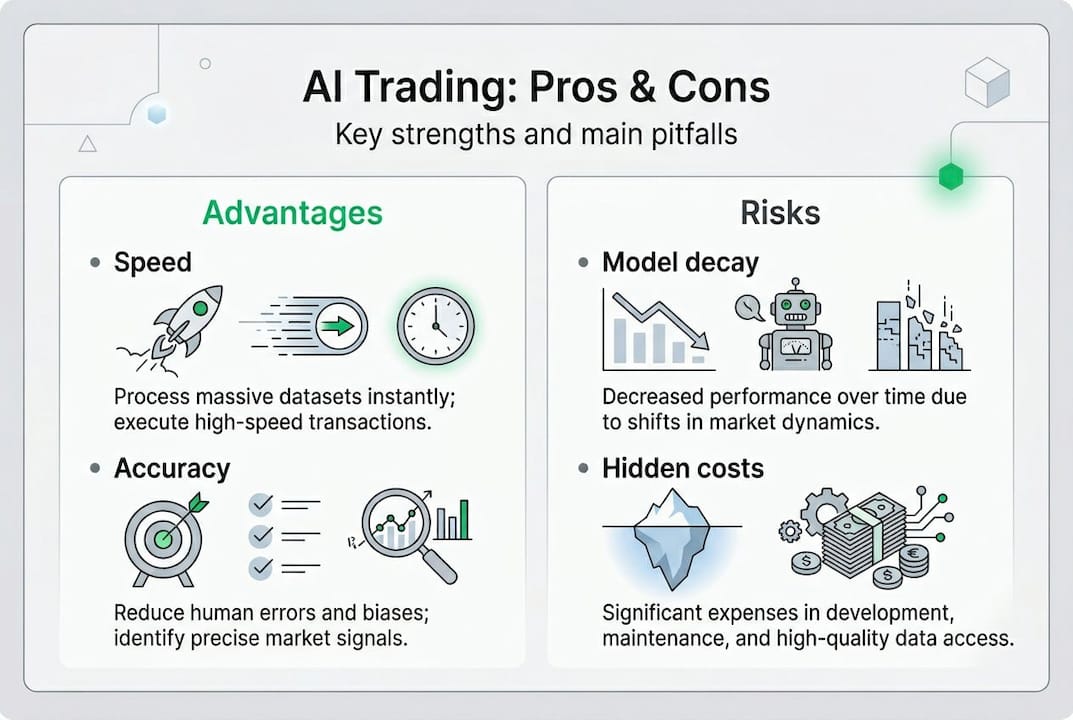
Hidden costs like slippage, fees, and taxes erode AI-generated returns significantly. A strategy that shows 12% annual returns in backtesting might deliver 5% or less after real-world costs are factored in. This is not a minor detail. It can be the difference between a profitable system and a money-losing one.
The key risks to manage:
- Pattern decay: AI models trained on historical data lose their edge as market behavior shifts. A model that worked in 2023 may be obsolete by mid-2026.
- Slippage and execution costs: High-frequency strategies are especially vulnerable. A few basis points of slippage per trade adds up to significant drag over hundreds of trades.
- Tax drag: Frequent trading generates short-term capital gains, which are taxed at higher rates in most jurisdictions. AI doesn't factor this in unless you explicitly build it into the model.
- Regulatory traps: PDT rules, leverage limits, and reporting requirements vary by market and broker. Automated systems can unknowingly breach these rules.
- Over-reliance on the model: Traders who stop thinking critically and just follow AI signals are the most vulnerable when the model breaks down.
Building safeguards is non-negotiable. Explore AI trading risks and costs in detail before you go live. Set hard drawdown limits on any automated strategy. Review model performance monthly, not annually. And always paper trade a new AI setup for at least 30 days before committing real capital.
Pro Tip: Before deploying any AI strategy live, calculate your true break-even win rate after fees, slippage, and taxes. Most traders are shocked to find it's significantly higher than the raw backtest suggests.
The real edge: Mastering both human and machine for trading success
Here's what separates the traders who actually profit from AI tools from those who lose money chasing the hype: humility. The best AI traders we've seen treat their models the way a pilot treats autopilot. Useful, time-saving, and powerful, but never something you hand the controls to and walk away from.
Markets punish complacency. An AI model that worked brilliantly for six months can start bleeding capital in week seven when the market regime shifts. The traders who survive and thrive are the ones doing routine reviews, updating their assumptions, and combining their own market intuition with what the machine is telling them.
The real edge is not in finding the best AI tool. It's in building the discipline to use it correctly. That means logging every trade, reviewing AI calls against actual outcomes, and staying honest about when a strategy is no longer working. Lasting performance gains come from that kind of systematic self-improvement, not from outsourcing your judgment to an algorithm. Human expertise guides technology. Not the other way around.
Ready to make smarter trading decisions with AI?
If you're serious about putting these evidence-based methods into practice, you need tools that support a hybrid approach rather than pushing you toward blind automation.
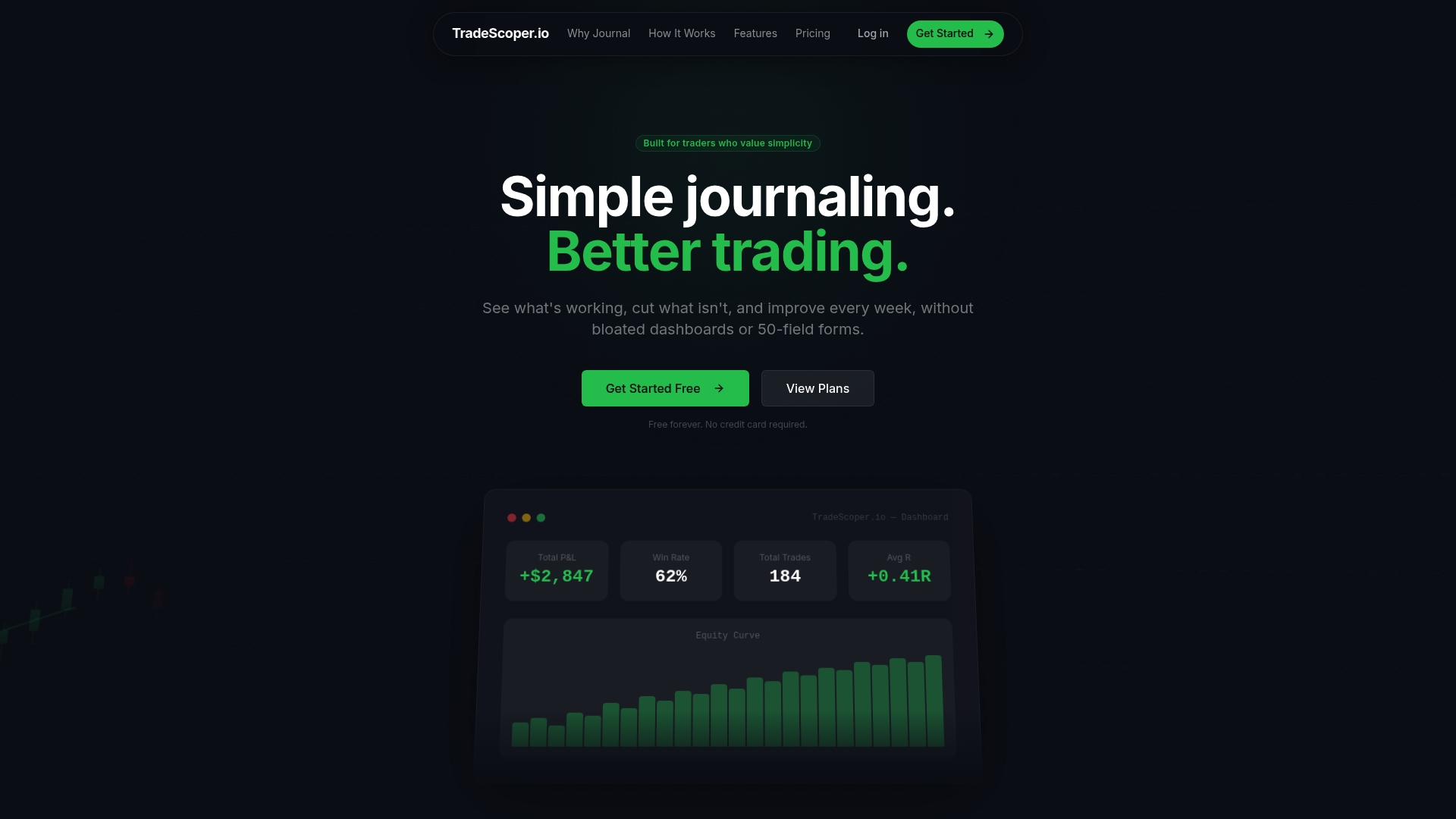
TradeScoper.io is built for exactly this. The AI Analyzer tool surfaces patterns in your own trade history so you can see where your edge actually lives. The performance dashboard gives you a clear, real-time view of what's working and what isn't across all your accounts. And the AI trading journal makes it fast and easy to log trades, track emotional states, and build the behavioral data that separates consistent traders from the rest. Start free and see the difference systematic tracking makes.
Frequently asked questions
Does AI really outperform traditional trading methods?
AI can beat traditional strategies in specific market conditions, but 47% to 67% of AI accounts underperform a simple buy-and-hold strategy over time, and 67% of retail AI bots fail to beat buy-and-hold within 12 months.
When does AI trading work best?
AI performs best in stable-pattern markets like certain equities and major forex pairs, where LSTM and ALFA models have shown measurable returns, but it struggles in fast-changing environments like crypto.
Can I fully automate my trading with AI?
Full automation carries serious risks from market regime shifts and model decay. AI plus human oversight consistently outperforms pure automation, especially when regulatory compliance is a factor.
What risks should I watch out for when using AI in trading?
The biggest risks include pattern decay, slippage, hidden fees, and tax drag. Hidden costs and regulatory risks are the most commonly overlooked factors when evaluating whether an AI strategy is truly profitable.