
TL;DR:
- Most retail traders lose money due to volatility and poor risk management.
- Success in crypto trading relies on systematic strategies, disciplined analysis, and risk controls.
- Regular journaling and data-driven review are essential for long-term improvement and edge.
Most new crypto traders walk in expecting fast profits and walk out with depleted accounts. Most retail traders lose money in crypto due to volatility and leverage, yet the market keeps pulling in fresh participants with promises of overnight gains. The reality is more nuanced. Cryptocurrency trading rewards those who understand market mechanics, manage risk systematically, and treat trading as a skill to develop, not a lottery to win. This guide cuts through the noise and gives you a clear map of how crypto trading works, which strategies actually hold up, and what separates traders who survive from those who don't.
Table of Contents
- The basics: How cryptocurrency trading works
- Popular trading strategies: From HODL to high-frequency
- Mastering market analysis: Technical, fundamental, and sentiment tools
- Managing risk: Surviving crypto's volatility
- Advanced nuances: 24/7 markets, volatility, and institutional edges
- Why most traders miss the real edge in crypto
- Ready to trade smarter? Track, analyze, and improve your crypto performance
- Frequently asked questions
Key Takeaways
| Point | Details |
|---|---|
| Crypto trading basics | Trading crypto involves buying and selling digital assets using spot, margin, or futures on different platforms. |
| Strategy selection | Choose trading strategies based on your goals, time, and risk tolerance—popular options include HODL, DCA, and day trading. |
| Analysis is key | Combining technical, fundamental, and sentiment analysis helps you make informed trading decisions. |
| Risk management | Use careful position sizing, stop-losses, and diversification to reduce large losses from the market’s volatility. |
| Professional edge | Pros succeed with systematic approaches and disciplined journaling, not by chasing quick gains. |
The basics: How cryptocurrency trading works
Cryptocurrency trading is the buying and selling of digital assets like Bitcoin on exchanges to profit from price changes. That definition sounds simple, but the mechanics underneath it are anything but.
At its core, trading involves three main formats. Spot, margin, and futures trading via CEX or DEX platforms each carry different risk profiles and capital requirements. Spot trading means you own the actual asset. Margin trading lets you borrow capital to increase your position size, amplifying both gains and losses. Futures contracts let you speculate on price direction without owning the asset at all.
Platforms fall into two categories. Centralized exchanges (CEX) like Coinbase or Binance act as intermediaries, holding your funds and matching orders. Decentralized exchanges (DEX) like Uniswap run on smart contracts, giving you full custody of your assets but with less liquidity and more complexity.
Key trading terms you need to know:
- Liquidity: How easily an asset can be bought or sold without moving its price
- Slippage: The difference between the expected price and the actual fill price
- Order book: A real-time list of buy and sell orders on an exchange
- Wallet: Software or hardware that stores your private keys and crypto assets
- Market order vs. limit order: Market orders execute immediately at the best available price; limit orders only execute at your specified price
| Trading type | Owns asset | Uses leverage | Risk level |
|---|---|---|---|
| Spot | Yes | No | Low to medium |
| Margin | Yes | Yes | High |
| Futures | No | Yes | Very high |
For understanding spot and margin trading in a practical context, it helps to see how each type affects your capital exposure before you commit real money.
Pro Tip: Start with spot trading before you touch leverage. Getting comfortable with price action, order types, and platform mechanics without the risk of liquidation is the smartest foundation you can build.
Popular trading strategies: From HODL to high-frequency
With the fundamentals covered, let's examine the top strategies traders use for different goals, skills, and market conditions.
Common strategies include HODL, DCA, scalping, day trading, swing trading, and arbitrage, each suited to different trader profiles. There is no single best strategy. The right one depends on how much time you have, how much risk you can stomach, and how much experience you bring to the table.
Strategy overview:
- HODL (Hold On for Dear Life): Buy and hold long-term, ignoring short-term swings. Best for beginners with low time commitment.
- DCA (Dollar-Cost Averaging): Invest fixed amounts at regular intervals to reduce the impact of volatility. Removes emotional timing decisions.
- Scalping: Execute dozens of trades per day to capture tiny price moves. Requires speed, focus, and deep market knowledge.
- Day trading: Open and close positions within a single trading day. Demands technical skill and emotional discipline.
- Swing trading: Hold positions for days or weeks to capture larger price moves. Requires pattern recognition and patience.
- Arbitrage: Exploit price differences between exchanges. Increasingly competitive and often requires automation.
| Strategy | Time horizon | Skill level | Risk level |
|---|---|---|---|
| HODL | Years | Beginner | Low |
| DCA | Months to years | Beginner | Low |
| Swing trading | Days to weeks | Intermediate | Medium |
| Day trading | Hours | Advanced | High |
| Scalping | Minutes | Expert | Very high |
| Arbitrage | Seconds | Expert | Medium to high |
Empirical data shows that most retail traders lose money consistently, while professionals rely on systematic and quantitative approaches. This gap is not about luck. It is about process.
A critical stat: over 75% of retail traders lose money on a quarterly basis. Volatility and leverage are the two biggest culprits. For avoiding swing trading pitfalls, understanding entry and exit discipline is non-negotiable. And recognizing behavioral patterns in trading can reveal why you keep making the same costly mistakes.
Pro Tip: Match your strategy to your actual lifestyle. If you work a full-time job, scalping will destroy you. HODL or swing trading fits better with limited screen time.
Mastering market analysis: Technical, fundamental, and sentiment tools
Knowing your strategy is important, but applying the right analysis tools can make or break real-world performance.
There are three core analysis methods every serious trader should understand. Technical analysis uses charts, RSI, MACD, and Bollinger Bands; fundamental analysis examines utility and on-chain data; sentiment analysis tracks news and social trends. Each method answers a different question about the market.
Technical analysis tools:
- RSI (Relative Strength Index): Measures whether an asset is overbought or oversold
- MACD (Moving Average Convergence Divergence): Tracks momentum and trend direction
- Bollinger Bands: Show price volatility and potential reversal zones
- Support and resistance levels: Price zones where buying or selling pressure historically concentrates
How to conduct a basic chart analysis:
- Identify the current trend (uptrend, downtrend, or sideways)
- Mark key support and resistance levels on the chart
- Apply one momentum indicator like RSI to confirm trend strength
- Look for confluence between price action and indicator signals
- Set your entry, stop-loss, and take-profit levels before entering
Fundamental analysis in crypto means evaluating a project's real-world utility, tokenomics, development activity, and on-chain metrics like wallet growth and transaction volume. Sentiment analysis involves monitoring news cycles, social media volume, and fear and greed indexes to gauge crowd psychology.
"Professional traders don't rely on gut feelings. They backtest every strategy against historical data and only deploy it live when the numbers support it."
Using the right crypto trading tools alongside automated analysis methods gives you a structural advantage over traders who rely purely on instinct.
Pro Tip: Never build a trade thesis on a single analysis method. Combine technical signals with fundamental context and a read on market sentiment for the highest-quality setups.
Managing risk: Surviving crypto's volatility
Understanding the analysis side is key, but thriving as a trader in crypto also means knowing how to guard your capital against the market's biggest dangers.

Key risks in crypto include high volatility, leverage liquidation, exchange hacks, and impermanent loss. These are not edge cases. They are regular occurrences in a market that operates without circuit breakers or trading halts.
The most common crypto risks:
- Volatility: Prices can swing 20 to 30 percent in hours
- Leverage liquidation: Borrowed positions get wiped when prices move against you
- Exchange risk: Platforms can be hacked, frozen, or go insolvent
- Regulatory risk: Government actions can crash entire sectors overnight
- Slippage: Fast-moving markets fill your orders at worse prices than expected
How professionals manage risk:
- Risk only 0.5 to 2 percent of total capital per trade
- Always set a stop-loss before entering a position
- Diversify across assets and strategies, not just coins
- Avoid over-leveraging, especially in low-liquidity altcoins
- Keep a portion of capital in stable assets as a buffer
Professionals use 0.5 to 2% risk per trade, strict stop-losses, and diversification as standard practice. Meanwhile, 75% of retail traders lose quarterly because they skip these basics in pursuit of bigger returns.
Liquidation is especially brutal in leveraged positions. A 10x leveraged trade gets wiped out with just a 10 percent move against you. Cascading liquidations across the market can accelerate price drops dramatically.
Using a risk/reward calculator before every trade forces you to think through your downside before you focus on the upside. And tracking trades for performance over time reveals whether your risk management is actually working or just feeling like it is.
Pro Tip: Never risk more than you can emotionally and financially afford to lose on any single trade. Set your rules in writing before you open the platform.
Advanced nuances: 24/7 markets, volatility, and institutional edges
Beyond the basics and common strategies, let's explore what separates seasoned professionals and institutions from the crowd in crypto's relentless market.
Crypto's 24/7 markets amplify volatility at 3 to 5 times that of equities, with frequent slippage in low-liquidity altcoins, liquidation cascades, and exchange outages during peak stress. There is no closing bell, no weekend pause, and no safety net. This creates unique psychological pressure that retail traders consistently underestimate.
What makes institutional traders different:
- They use algorithmic systems that execute without emotion
- They analyze on-chain data flows that most retail traders never see
- They exploit speed advantages through co-location and API trading
- They size positions based on volatility-adjusted models, not fixed dollar amounts
- They treat drawdowns as data, not disasters
Retail traders chase returns and trade on emotion, while professionals prioritize risk-adjusted returns and volatility targeting. That difference in mindset compounds over hundreds of trades into a massive performance gap.
"The goal is not to maximize returns. It is to maximize risk-adjusted returns. A Sharpe ratio above 1 is rare in crypto, and those who achieve it are not guessing."
Most retail systems fail because they have negative skew, meaning they win small and lose big. Emotional trading amplifies this by causing traders to cut winners early and hold losers too long. Running a Monte Carlo simulator for crypto scenarios helps you stress-test your strategy against realistic market conditions before real capital is at stake.
Why most traders miss the real edge in crypto
Here is a hard-won insight from years of watching traders come and go in this market. The ones who survive are not the ones who found the right coin. They are the ones who built the right process.
Retail traders obsess over picking the next big token. Professionals obsess over their edge, their execution, and their review process. Pros prioritize risk-adjusted returns, systematic edge, and volatility targeting over emotional reactions to price movement. That is the real difference.
Data-driven journaling is not optional for serious traders. Reviewing your trades, tagging your emotional state at entry, and identifying recurring mistakes is how you actually improve. Most traders skip this entirely and wonder why they keep repeating the same errors.
Systematic processes beat emotional ones over time, without exception. The market does not reward effort or conviction. It rewards correct decisions made consistently. Using automated analysis for consistency removes the guesswork and gives you a feedback loop that actually teaches you something.
Pro Tip: Journal every single trade, including your reasoning, your emotional state, and the outcome. Review your patterns weekly. You will spot your blind spots faster than any course or mentor can reveal them.
Ready to trade smarter? Track, analyze, and improve your crypto performance
If you're ready to put these insights into action, the right tools make professional trading truly attainable.
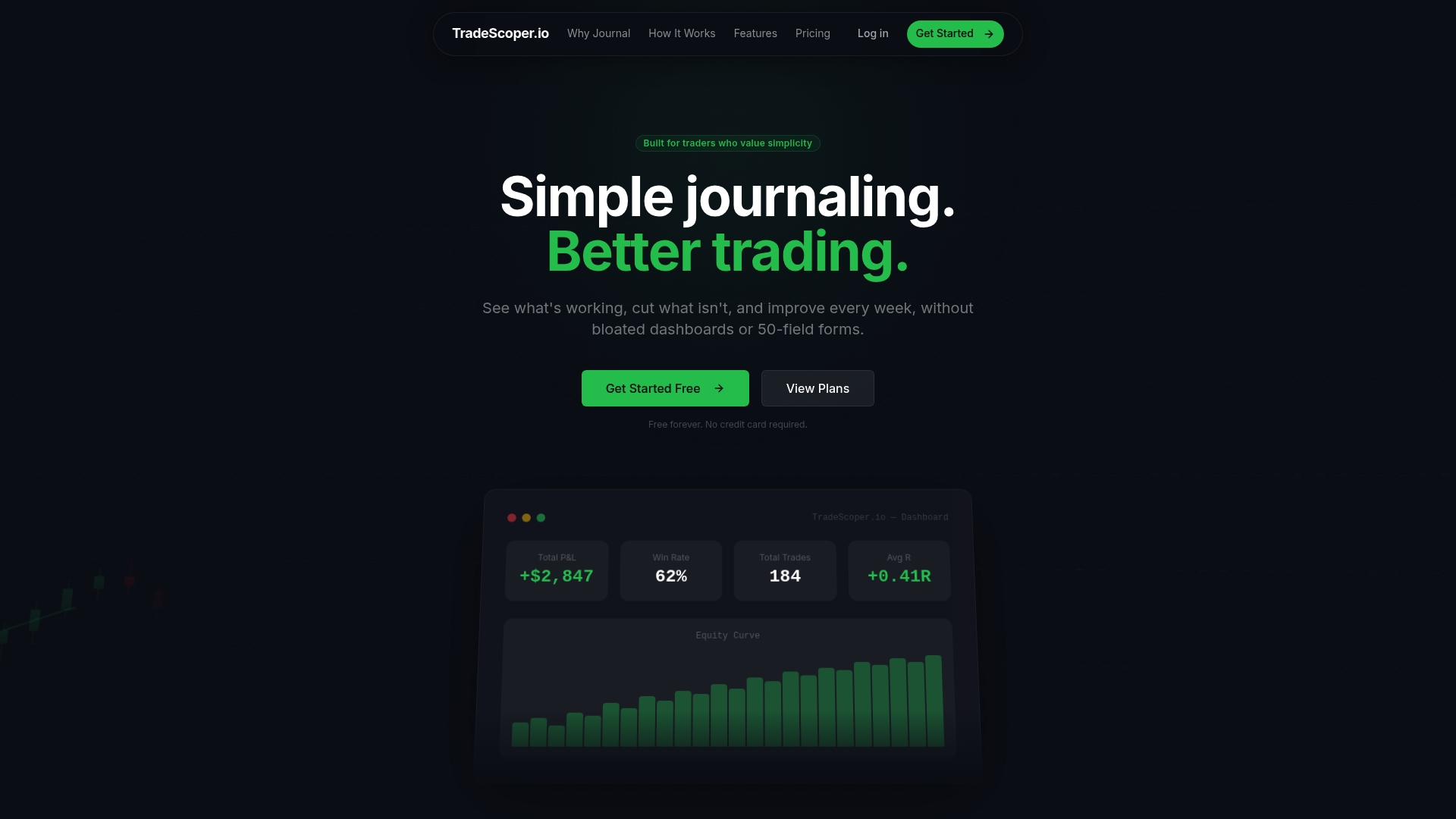
TradeScoper.io is built for traders who are serious about improving. The crypto performance dashboard gives you a real-time view of your win rate, risk/reward ratios, and behavioral patterns across every trade you log. The AI trade journal makes it fast to record entries, exits, emotions, and outcomes without the friction of spreadsheets. And the full suite of trading analytics tools helps you stress-test strategies, calculate risk, and identify what is actually working. Stop guessing. Start tracking. Your edge is in the data.
Frequently asked questions
What is cryptocurrency trading in simple terms?
Cryptocurrency trading is buying and selling digital currencies like Bitcoin on online platforms to profit from their price changes, similar to how stocks are traded but in a 24/7 market.
What are the main risks of trading crypto?
Crypto trading carries serious risks including extreme price swings, leverage liquidation, and exchange hacks. Most retail traders lose quarterly without disciplined risk controls in place.
Is cryptocurrency trading different from investing?
Yes. Trading targets short-term profits from price swings, while investing means holding for long-term growth. HODL is long-term investing, while scalping and day trading are short-term profit strategies with very different risk profiles.
How do I choose a crypto trading strategy?
Start with your goals, available time, and risk tolerance. Strategies like HODL, DCA, and swing trading suit different lifestyles and experience levels, so match the method to your actual situation, not the one with the most hype.
Are professional traders successful in crypto?
Some are, but it is not common. Systematic and quantitative approaches give professionals an edge over emotional retail traders, though even seasoned pros face significant drawdowns in this market.
Recommended
- Day trading tips: proven strategies for profitability in 2026
- Forex trading analysis: methods & behavioral insights
- Automated trading analysis: boost performance & cut risk
- Blog | TradeScoper.io
- Crypto Trading Strategy Optimization for Profitable Automation
- 12 essential trading strategies to boost your edge in 2026